Red Box Main man Simon Toulson-Clarke was interviewed by our music industry expert Richard Rogers and Simon had a lot to say about the new Red Box album and the way the industry works in 2019.

Richard Rogers:
Hi Simon and thank you for the interview for the Music2deal website, the online worldwide music industry platform. You’ve got a new single out called ‘This Is What We Came For’. The sound is fairly poppy and musically there are snippets where it harks back to both ‘Lean On Me’ and ‘For America’. Was this intentional?
Simon Toulson-Clarke:
Not even slightly intentional! I think we have a sound and this song is a product of that…it’s our own sound and it was true of us in the 80s, too. We were perhaps atypical of what was generally going on in the 80s but I think it is the reason that although we may not have as many fans as some bands those who love us love us with a total, immersive passion.
To write ‘intentionally’ assumes a skill I don’t possess. I write to please myself and my bandmates who also happen to be my closest friends. If it emotes with us we simply hope others may feel the same. And that’s about all there is to our intent.
RR: The excellent video for the new single ’This Is What We Came For’ looks particularly exotic. Where is it and what made you choose that location?
STC: It is Thailand, specifically the stretch of Indian Ocean coast near Ranong on the Myanmar border, a very beautiful and undiscovered part of the country. I was there on holiday in January with my wife and daughter. When ‘This Is What We Came For’ was chosen as our first single we thought the easy-going people and the happy place fit the song perfectly.
RR: ‘This Is What We Came For’ is a taster to your 4th album ‘Chase The Setting Sun’. When is the album released and can we expect more of the upbeat pop of the single?
STC: We will release 2 or 3 singles before the album, a bit of old skool thinking I suppose. I think this album is very strong and I’m extremely proud of its consistency. It is probably closer in temperature and style to our first album ‘The Circle & the Square’ than anything else we have done, although I’d like to think it is a continuing evolution and that we have learned something about ourselves and about what we do along the way. That is probably because we have settled into a permanent line-up in touring, writing and recording; most definitely our best and most creative incarnation of the band. We have become very close friends over the years and I think that has helped us get better and play together better.
The new album has more uptempo songs than slow songs and I believe it is melodic, harmonic, lyrical and bouyant. So yes, it has some pop songs on it and some reflective moments, too. And again, we don’t really intellectualise the process: it is the sound we make together, pure and simple.
RR: It is over 8 years since the ‘Plenty’ album, why such a long gap between studio albums particularly considering that album received such a positive response from the music industry?
STC: No mystery. There are two main reasons:
Firstly, we are quite slow in going through the process of writing and self-filtering – not in recording, we record quite quickly once we commit to it – but we circle the problem for some time when we are songwriting and we are demo-ing every idea as we circle it. We have our own studio which helps and for Red Box this has been the main reason we remain hungry to create and to play. We stockpile anything between 35 and 45 songs before we decide we are ready to make a new album. And to distill this down to the essence, the best 10 or 11 songs, we will probably record all 45 of those songs to something like 80% completion. And in addition, we may well record up to 3 or 4, sometimes 5 or 6, versions of the same song – in different keys, at different speeds, maybe a guitar version, an orchestral version, a piano version….and so on. Then we sit for a long while listening to all these disparate pieces of music, looking for common threads, for meanings and a subtext that is consistent in direction or emotion. Like waiting for the needle of the compass to settle. Only then do we proceed.
I think a good Red Box song is where TWO ideas collide and that can be musically or lyrically, or even better, both. So this stage of the process is quite time hungry. But at the end of it we come out of the studio and say…”We are gonna make THIS kind of a record”. We need to feel a strong sense of direction and context at that point or we’d just end up making a random collection of 10 songs much more quickly! But I think, for Red Box, our album has to feel like each song sits with the rest, and that together they paint different colours but belong to the same body, like scales on a fish. Not sure how I ended up with a fish at the end of that explanation, but hey…
The second reason is that we live our lives. We all have families and we spend time with them, doing things that are important to our children. For instance, my daughter is a very talented young show-jumper and I travel all over the UK and sometimes Europe to be with her at competitions. We also like to travel whenever we can afford to. So although music and creating songs, touring and playing together as a band is INCREDIBLY important to us, we want it to be in proportion with our other lives and those of our loved ones, and to reflect those real experiences. This is also the reason Red Box travel on tour with a large family entourage. It makes the band less profitable but considerably more enjoyable.
RR: You appear to have left Cherry Red Records and are now on Right Track Records. Why the breakup with Cherry Red and is Right Track your own record label?
STC: We never signed to Cherry Red, we simply granted them a license to distribute our last album ‘Plenty’. And although we will forever have fond ties with Cherry Red, we share a history after all, this time around we felt that Right Track (it is not our own label), who are distributed through Universal were better suited to the kind of record we have made. We get on very well with them, they have great individuals working press and radio and they are completely supportive of us making our own creative and musical decisions.
RR: Is it the same studio personnel line up you used for the ‘Plenty’ album?
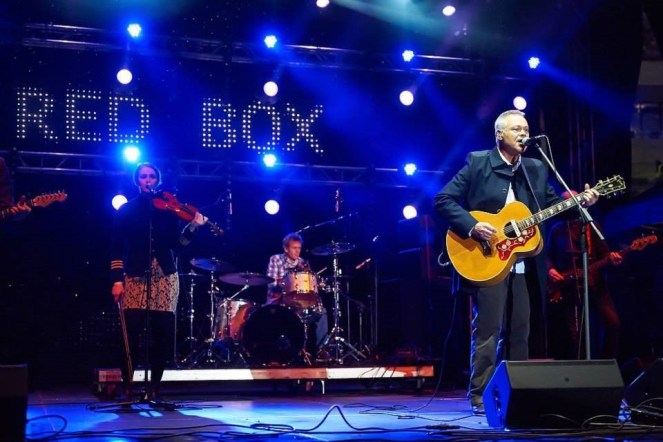
STC: Yes pretty much. Red Box is a core of 5 or 6 musicians which is relatively unchanging: STC (lead vocal and guitar) Derek Adams (drums, guitar) Dave Jenkind (bass) Sally-Jo Seery (vocals and guitar) Karin Tenggren (vocals, violin, cello and keybards) and Michal Kirmuc (percussion and guitar). When we make an album we invite one or two guest musicians to join us on certain songs, friends who have particular musical skills to join us on recordings where we feel it would be fun and musically fertile. We call this extended circle ‘Associate Members of RB’ and where possible they will join us when we play concerts: Ali Ferguson (lead guitar) Alastair Gavin (keyboards) and Ty Unwin (keyboards and strings) are all contributors in this way to our new album.
RR: With ‘Plenty’ you toured fairly extensively for three or four years after its release. Will you do the same for ‘Chase The Setting Sun’ and are there any tour dates on the horizon (excuse the pun)? STC: We will tour everywhere we can, anywhere that will have us! Initially we are planning a London concert, maybe two, and one of those may be an acoustic show. Then we will look at the major cities and towns in the UK. In Poland we just confirmed that we’ll headline a festival in Rzeszow in Poland on 31 August and we are discussing a concert at the Earth Hall in Poznan for 29 September. There is talk of Holland, Belgium, Germany and Sweden and Denmark too, so we are just hoping that all of this will come together. The simple answer is that we will play concerts anywhere we have some success with the new album, we need some media attention in any given country to make concerts possible. Right now we are seeing how the single goes and we will be talking to promoters about some dates around the time of the album release. So although I can’t give you many specific dates and places I would ask anyone who is interested in the band, in seeing us play live, to ‘friend’ us on Facebook Red Box – Home or check out our website Red Box | Band | Official Website for up-to-the-minute news. RR: Lyrically are there any recurring themes on the album?
STC: There are common threads within the songs on our albums and although we are mostly unaware of what they may be when we are putting them together, it becomes very obvious when we step away from it. Listening again to our new album ‘Chase The Setting Sun’ we think it is about hope, redemption and the realisation that the precious things in life may well be closer than you think: family, acceptance, love and friendship, which for us is closely bound up with making music. We are saying “we are still here, we love what we do, we value our bond and our close families”. And that, at a time when many of us are very concerned about economics and having enough money, hope redemption and love are free! We almost called this album ‘Insiders’…because there is another thread that runs through it. We have often discussed that we are all, each member of the band to some degree, misfits and outsiders. It may be how we found each other and why it took over 10 years to do that. We don’t conform – not in a belligerent or deliberately antagonistic way, but it’s there, we simply find ourselves outside the mainframe and I don’t mean this in the musical sense…although that may also be true. And I think that fans of the band often find themselves walking the same path. The band and its listeners are happy to take a different view. We are often happy with our own company and with our own music. Don’t get me wrong…we are FAR from antisocial and we are in good humour. But we are all definitely content on the OUTSIDE looking in…. So in a sense when the band play together – and particularly in front of our audience who know us and the music – we all become, for a moment at least, IN-siders. It’s the Temporarily Insider Club! TIC!
RR: Both ‘’The Sign’ and ‘Hurricane’ from ‘Plenty’ did very well in Poland. Why do you think there was a special affinity with Poland.
STC: Two reasons: Our first single ‘Chenko’ (1983) was a huge hit in Poland because it became synonymous with their emergence from Communism. It was one of the first western records to be played on radio which previously had only been permitted to broadcast classical music. So the good luck of timing, really. ‘Chenko’ is a song woven around a Native American chant and is loosely based on the story of my hero Crazy Horse; it is about seismic change. It contains the chorus lyric “It’s over!” and clearly this resonated with Poles, a proud people who were just lifting their heads to look the world in the eye in the aftermath of Glasnost. The second reason is that in Poland, as with a number of European territories for us, if you were successful in one era they are very enthusiastic to listen to what you have done recently. This is in sharp contrast to the UK, where there is a distinct pressure on you to remain what you once were – in our case a quirky 80s pop group. Here in the UK for a band who have been there and done it in a previous era it is far more difficult to get your new music heard.
RR: Sincerely good luck with both the single and album, is there anything else we can expect from Red Box on this campaign?
STC: We simply hope to entertain our fans, perhaps find some new ones, and entertain ourselves in the process! It’s gotta be fun. Our music comes from the heart, we are not the most prolific or quick band in the world but we mean every note. We want to find music lovers who think this may be their cup of tea and have a lasting relationship with them.
RR: Thank you for your time Simon. The new Red Box single ‘This Is What We Came For’ is available to stream now on the usual suspects Spotify, Amazon, Apple and Google Play.
STC: No problem, thanks for doing this piece, Richard.
RR: Since ‘Plenty’ eight years ago,the music industry appears to have changed beyond all recognition with physical product almost entirely out the window now. Two questions here, what is your take on the current ever evolving music industry and secondly will you be releasing any physical product such as vinyl for any of the new releases?
STC: I’m going to answer the last bit first: we’d love to release on vinyl but we will take a view of it once we see how well our record is doing. Vinyl is wonderful, a lovely addition but it is relatively expensive to manufacture these days so you need to know there is a large enough market for a particular album before you commit to it. So, basically, when it comes to releasing on vinyl we want to, we hope to.
We will manufacture physical CDs to sell on tour because fans like to have a signed memento of the evening.
Regarding the evolutions of the industry:
Artists can now make and distribute music without a major label and this is particularly true if you can connect directly with your fan-base and grow it through social media. In the early 1980s, the means of production – a master-quality studio – cost £2-3 million to set up and equip. These days, with ever-shrinking and ever-improving digital hardware, you can get a good result in a studio that cost as little as £50,000. Even if you can’t set that up for yourself, it can be hired at a fraction of the cost of Abbey Road or Air Studios. So the label’s role has changed and so has the artist’s.These days, the record companies also want a share of touring and merchandising profits because live has become the most lucrative sector of the business – it’s called a 360 degree deal. Sometimes a new artist can get favourable terms – perhaps up to a 50:50 split with a more enlightened label – and it may still make sense because they are going to need A&R help making an album and expertise and connections in marketing it. But it’s not a simple decision because the label will own the master rights forever. He who pays the piper calls the tune, that much hasn’t changed.And there have been many notable modern successes recently where a switched-on management with an artist adept at social media simply hires the distribution services of a major label.
This is how Red Box are releasing our new album – we have a following, a few supporters in radio and we are distributed worldwide by Right Track through Universal Music on far more generous terms. We all need a bit of luck in making an impact and it can come down to just one song.And a further great change has been in sales numbers. I heard there was a recent No1 with total sales of 12,000. In the mid 80s in order to stay in the top 3 on the chart our song ‘Lean On Me’ was selling 35,000 copies per day! Streaming is the future but I’d love to see a fairer distribution of that income.Because streaming is in principle a great and positive step for artists as it allows a more direct route to fans and casual listeners alike.
But the earnings are very small. I love Spotify, I just wish musicians owned it instead of the major labels. Things change outwardly and yet they don’t on the inside!The major labels remain the gatekeepers at radio and on Spotify. Is it right that the majors should continue to exert a huge influence on streaming (and, enduringly, radio) playlists and to cream off the lion’s share of the income whilst arguing that its OK because artists can, under certain circumstances, now earn money from touring? Although selling or streaming our recordings empowers touring I think it would be healthier to see both ‘recording’ and ‘touring’ as interdependent, mutually beneficial commerce, where each is profitable – or at least sustainable – in its own right. It’d be healthier artistically. And healthier art is good for business.
For example, and I just googled this… if you are on a label, for every album downloaded your record company takes approximately £4.00 and Apple keeps £2.80. Artists get 7p for each individual song downloaded on Napster and iTunes. To put that into perspective, musicians need to sell 12,399 songs a month to earn a salary equal to a McDonald’s employee. Streaming (Spotify, YouTube etc) pays even less, a song has to be extremely popular to move the needle.It took over three years to write and record our album and our we will profit by between £0.80 for a download and £5.00 for physical CDs we sell at gigs. Set against that will be many costs along the way. Whereas the T-shirt that bears the album artwork took 2 hours to self-design and will sell for £22. Go figure…If the central pillar of music creation – recording and selling your original compositions – becomes unprofitable except for the small handful of top artists on major labels, not only does this limit diversity and consumer choice but it also reduces albums and singles to the status of mere marketing tools for the tour and the T-shirt. You go from albums as flights of artistic possibility — the music of our dreams pursued with artful invention, no less – to live recordings in small clubs made with decent microphones. Not so much Sgt. Pepper’s Lonely Hearts Club Band as The Beatles Play Live in a Neasden Pub…
One of the interesting evolutions within the industry is that never before has there been so much technical analysis and demographic feedback available to the producers of music and yet – at the creative edge of the art form we remain blissfully in the dark – in a very good way in my opinion! Sure, we can quantify, analyse and replicate – but that gives us formulaic music in any genre. It’s been done many times with varying degrees of success throughout history but the real pioneers, the adventurers, from Bach and Mozart to The Beatles and Bowie, from James Brown to Prince, Dylan to Eminem – there are many examples – those great artists and composers forged their own highly individual path.
There’s a crucial difference between inspiration and inferior mimicry here. I believe that both artist and listener have a duty to explore further and to aim higher, filter out the background noise, sift the sand and find those nuggets of gold. Mimicry of what is currently successful is an age-old trend and although it has never been more prevalent than today, as artists we don’t have to replicate. We can actually explore, be bolder, chase originality down and find our own voices. And as listeners we don’t have to listen to the logjam of samey, wannabee songs and recordings that some sectors of the industry push towards us via the mainstream.
Links:
Red Box – Home
Red Box | Band | Official Website
Music2Deal.com



 The Music2Deal Blog