Music2Deal pulled off a real cracker last month when Richard Rogers interviewed producer Ade Fenton about the new Gary Numan album Savage (Songs From A Broken World) that was released last week. We are proud and extremely pleased that the album looks to have gone in at number 2 into the UK Chart this week beaten off only by the new Foo Fighters album but with almost almost 3 times the sales of Ed Sheehan in third place. In fact the Savage sales and chart position is even more startling as it steamrollered ahead of new releases from Cat Stevens, Madonna’s new Rebel Heart album and the new Doors compilation. It is 36 years since Gary Numan last had a top 3 album and in part two of the interview Ade and Richard talk about the new album, Dj’ing, how Sennheiser was important to both of them and working on film soundtracks.
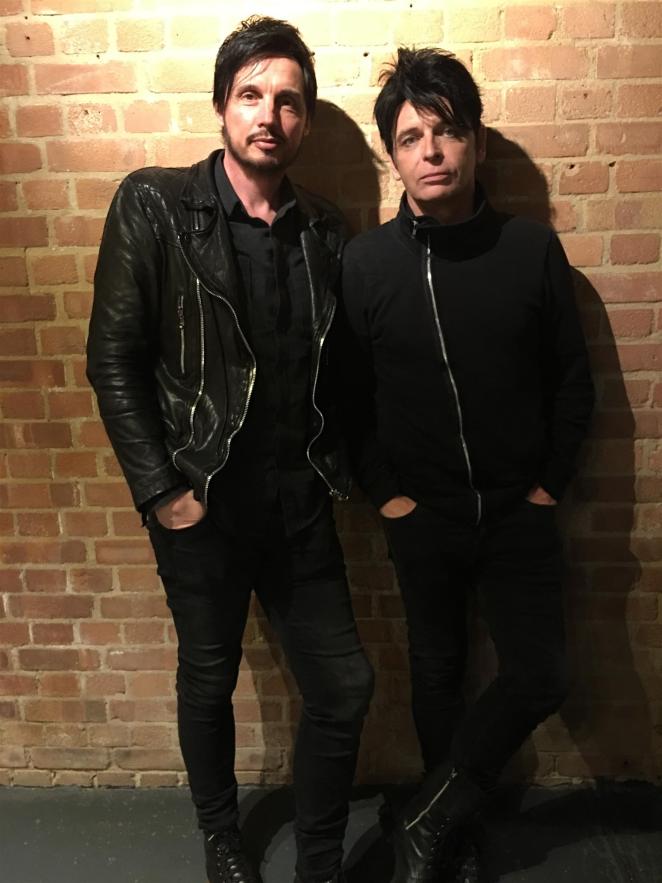
Ade Fenton with Gary Numan
RR: You’ve put out over 40 releases so when was your first release?
AF: 1998 or 1996 I can’t remember. I’d got really into the techno thing, I just happened to be going out with a girl and she had these turntables and we’d gone into the clubbing scene quite big and she’s gone into the house scene and i’d gone down the techno path because I liked aggressive music and I started messing around with these turntables and I realised I could beat match really easy. I had a normal job for many years and I was made redundant so I took all my mates to Ibiza with my redundancy money and had the best two weeks of my life. I came back with no money and thought ‘What am I going to do now?’ So I decided I’m going to give making music a go because I was so in love with the scene. So I started making music with an old program called Cool Edit Pro not knowing what I was doing so I just taught myself. I found a distributor for the record and put my email and number on the record and the calls just kept on coming in and it took off. There you go, timing, it was a shit record, really embarrassing now but it is what it is. Later I met Gary Numan and I was into industrial music and realised i’d learnt what I needed to do.
RR: What is your favourite release of your own material?
AF: I did an album in 2007 called Artificial Perfect and Gary guested on the album and we did a track called Recall. I listen to the rest of the album now and go ‘What the fuck was I thinking?’ but Recall was quite a dark track after I broke up with a girl at the time and I was in a low place. I can listen to that song and think ‘Crikey I like that it’s quite good’ and i’m quite self deprecating. All the stuff with Gary has been the highlight year after year. Dead Son Rising Gary and I wrote together and was a huge stepping stone from Jagged in terms of production. Splinter i’m obviously massively proud of but with Savage it feels like the next level again, and i’m very proud to have produced it.
RR: From the My Name Is Ruin single it feels like a great taster for the album and slightly exotic with the structure of the song which is so different to anything out there. It seems very eastern based with a pumping rhythm. Was that your idea or Gary’s?
AF: That was Gary’s. It is very electronic. We stuck very rigidly to the structure and when Gary gave me the song we ensured the drums are processed to hell through a Sherman Filterbank so it’s really gnarly and with all the sparkly bits and everything. I did think of the structure at the time like yourself ‘Blimey, that’s unique’. It felt like we could be more experimental on the new album than Splinter. I’’m saying this in inverted commas but there isn’t really an industrial rock track on Savage like there perhaps was on Splinter. Because it’s a half concept album there is a story behind it like there was with Replicas or even Dance it is one of the reasons we went full on with it and it’s quite war like in places and in other places it’s really stripped back and there’s a track called ‘And It All Began With You’ and it’s very gentle and minimal with weird electronics and with a thunderstorm going through the song, very experimental and we’re both very proud of that.
RR: That’s a beautiful song, lightly sung and atmospheric almost hypnotic. I will put that in one of my DJ sets. Are you still DJ-ing now?
AF: Not really. I still do the occasional thing if i’m asked to do it and I like it. It’s like riding a bike I can still do it reasonably well but I just have other things going on really and having a young toddler of 16 months, I don’t want to miss anything with him at the moment. I don’t want to miss him putting his first sentence together, depending on what he says of course.
RR: If you were going to have a basic budget DJ set up what would it be to get you started?
AF: I always went with a Mac running either Serato or Traktor and personally I love digital vinyl. A lot of people use CDJ’s and I can but I really love digital vinyl and my personal choice of mixer was Pioneer DJM 600 or 800 as that was my preference as I loved the digital effects on board. DJ-ing has a different meaning now and DJ-ing can be put in inverted commas and for me it’s not really DJ-ing. DJ-ing was mixing records together and that’s not always the case now which is why I love people like Dave Clarke as there is proper skill in that. PMC 228’s are my speaker choice but they are not budget speakers, I think they retail for nine or ten grand and i’ve had them for 3 or 4 years. I chose PMC because the clarity is ridiculously good and they do a more affordable range although they are still not really budget but if I were to recommend monitors to anybody I do recommend PMC.
RR: On the headphone side i’ve always loved Sennheiser, i’ve got three pair of them and still have a pair from 1989 without the foam surrounds sadly as they wore away. I bought a fabulous pair of cordless ones last year too, the HDR 118’s. What would you recommend?
AF: I use Sennheiser as well. Several pairs of them, absolutely battered some of them as well particularly my old DJ-ing Sennheiser headphones. Sennheiser is all I use to be honest. I’ve got some with the mic too. Sennheiser were always reliable and the quality second to none.
RR: I always found them a superb company for headphones particularly the overall sound and design, I think they are German but I don’t know where exactly they are based, I know they also do microphones but I never used any in the studio as the Sennheiser microphones were more difficult to find in the UK. It should be easier to find now I live near Cologne.
AF: I didn’t know you could get Sennheiser mics, are they studio mics?
RR: If truth be known, I don’t know. I’ll find out and ask them. I co-produced the last Karel Fialka and Racecar album (Karel had a huge hit in the GAS territories with ‘Hey Matthew’ in the eighties with over 650,000 copies sold and a lesser hit in the UK too) and I always ensure we do a playback session when a project is completed to sort out any minor glitches. I invited the guys from the project over, one said ‘no it’s OK, we don’t need a playback session’ and the other never bothered to show up. Incredible, you always need playback sessions no question! For me I always listen to the album on my old Roland Monitors for an open playback and then with the Sennheiser headphones for a closed playback. There were only me listening through headphones and the Sennheiser cans picked up a lot of production faults a treat. Startlingly so. I always advise artists to have two playback sessions as well as outside professional mastering. Sadly some artists never listen. So for any Music2deal members out there what is one piece of advice you would give them if they were thinking of treading a path into the music industry professionally?
AF: Apart from buying Sennheiser and PMC products for quality I would say for the music industry, always have a back up plan. You’d be very lucky if things fall into place really quickly these days because making money out of music is very difficult. I was dead lucky, timing is a massive thing as well. I was lucky that when I started the first record I ever made sold quite well and I started getting DJ bookings and suddenly i’ve got a career. For me I’ve got into the film world as there is no age barrier in being a composer and I love making music for film and TV. For me it was a long term decision to do that as there will come a point that i’m not as young as I used to be and that matters less in Film and TV. So my advice is have a back up plan but if you make it work it is so worth it?
RR: What other projects are you working on?
AF: I’ve been working with Jayce Lewis who is supporting Gary Numan on the forthcoming World Tour as well as a band called Puzzle who are superb. Other than as I mentioned i’m really trying to get into the film music, film soundtrack area and music for TV. The next TV project out is 8 Days That Made Rome. Gary Numan and I did a soundtrack a couple of years back to a film called From Inside and i’ve been involved in a lot of horror soundtracks but i’d like to broaden the scope if I can.
RR: Are you aware if the deal for the Savage album with BMG is a one album deal or more?
AF: As far as I know it’s a one album deal but I’m sure there are options in the contract.
RR: Will you be going out on the road for the Savage Tour?
AF: Unfortunately not as I have other booked work coming up. Even today i’m working on a remix of a track from Savage that will be an extra track on the Japanese version of the album. It’s a bit of a mad remix.
RR: Finally, apart from Gary Numan, if there is one other artist you could collaborate with who would it be?
AF: Oh come on you know the answer to that one – Trent Reznor of course.
RR: Ade, thank you very much for your time and good luck with the release of Savage.
AF: My pleasure, thank you.

 The Music2Deal Blog