German · Tips

How To Prepare To Work With A Music Producer

Brad Chapmen
by Brad Chapman

Brad Chapman has been doing vocal pre-producing for over 35 years, and developed a signature technique for producing FEEL while working with producers and artists such as: Quincy Jones, David Khane and 100+ Grammy winners.


1. Personalized Warm Up Exercises:
Learn how to warm up your voice with exercises specifically for you. Canned warm ups or YouTube warm ups, most likely won’t work well for you (they might even hurt you.) Your warms up should be specifically for you.
Singing songs is an ineffective way to warm up, as you could be tiring out your voice; rather than warming it up. Why do I stress this topic? Being warmed up to your best vocal condition, will keep you from being distracted by your voice and keep your mind on the story line and emotions.
My phrase for this is ‘sing from feel’. Feel the emotion first and then sing them out. If you do cardio and or a steam room, do these before you do your warm ups. Especially if you have an early morning performance.

 
2. Constantly Train And Be Prepared:
Start pre-production now and never stop. You must always be preparing for the right moment. A quote from Grammy winning Jeff Bhasker is: “If you’re not completely ready for me, I won’t produce you”. This is something I hear more and more from seasoned producers. They don’t want to train and develop you. It’s up to the vocal artist to be trained and prepared.
Developing a strong belted-head-voice will keep the producer from having to fight to record your voice due to overloading the pre-amp. (Don’t yell on your high notes.) If producers have to limit the sound, this results in less color in your voice. Also, intimate passages are difficult to record unless you can control the volume dynamics thru belted-head-voice.

 
3. Work With Someone During Vocal Tracking:
Train your voice and ears for the microphone, headphones, floor monitors, and in ear monitors. There is always someone running your sound system or vocal tracking (at least there should be.) I realize that there are a few stories of artists like Prince and Todd Rundgren self-producing. (However, I doubt that they were alone during the vocal tracking.) The reason you want to work with someone during your vocal tracking is that it is quite complicated to engineer and focus on your emotions of the song.
The totally self-produced vocals I’ve heard, lack feel and that’s what the vocal needs the most. Remember always that singing is communication to your fans. Having a producer in the studio helps make sure you are communicating, otherwise you’re
singing to yourself. If you’re producer doesn’t know that, ask him to listen as an audience would and give you feed back. Your vocal expression if far more important than the Sonic’s of the recording.

 
4. Befriend Your Producers:
Become immediate friends with your producers. Get them to like you, so that they care about your performance. (The average producer is like the average audience. If you don’t take care of your electronics, then they assume that you are not a quality singer. If you ’piss them off’, they may actually intentionally create a bad mix, where you can’t hear yourself.). Note: Please refer to Music Connection Magazine, cover page ‘Don’t Piss-Off The Sound Guy: http://www.musicconnection.com/dont-piss-off-the-sound-guy/
Your producer actually can purposely or accidently ruin your voice and your career.
When people hear you sing and you don’t understand the electronics you’re performing through, your audience will blame you for sounding out of tune and strained; and they should blame you. When you can’t hear yourself comfortably with headphones, in ear monitors or stage monitors; you will sound tone deaf and/ or over the top (meaning that you are trying too hard to hear yourself).

 
5. Monitor Feedback Is One Of Your Enemy’s
Buy a small mixer, microphone, head phones and floor monitors and use them every day (even while doing vocal exercises.) Learn about how the equipment works. Then, you can talk intelligently to your producer and make sure the recording studio and the live audience will hear you at your best; and consider you a good to great singer. When you put headphones on at the studio, you must communicate with the engineer/producer in order to make yourself sound great to yourself in the tracking mix.
Have your voice working so well that when the producer, stage or studio, doesn’t need to correct you; or if he does, you can make corrections on the spot. Always test your mic before the music starts. If you start singing with the music and your mic is off, it’s quite embarrassing and again the audience will blame you; not the sound man.

 
6. Feel Your Song’s Story; Ignore Mistakes During The Performance:
Ninety percent (90%) of your singing must have feel. Make sure that your vocal problems do not distract your conscious mind from the feel of the song. Your mind should be at least 90% on the story and how you feel about it.
The producers call this ‘feel’. They will always ask you for more and more feel, and emotional expression. They know that is the only way they can produce a performance
that means something to your fans. If you make a mistake, learn to ignore these and continue singing the song’s story with emotion; and stay in the feel of the music and the story.

 
7. Train Until The Song’s Technique And Emotions Are 2nd Nature:
How is this done? Repeat your song over and over again. You will develop the ability to stay in the story from beginning to end; never being distracted. At the same time, make the story’s emotions the only place you want to live in, as you feel the story.

 
8. Enjoy Your Performance And The Music:
Now, you will have a great time performing live and in the studio, and everyone attending will enjoy your great performance.

 
Brad Chapman Vocal Pre-Producer http://www.bradchapmanvocals.com

English

The State Of the Music Industry Is Bad,But It Has Still Seen Worse Days

While more music is being produced these days than ever before, this high production does not necessarily equate to the highest revenue of all time. In fact, it actually has equated to rather the opposite end of the spectrum.

2014 saw the smallest weekly sum for album sales since data tracking first began in the early nineties. This downward spiral included an 11-month wait for any artist to sell a million copies of a studio album, until Taylor Swift finally broke this dry spell when her album ‘1989’ dropped at the end of last year.

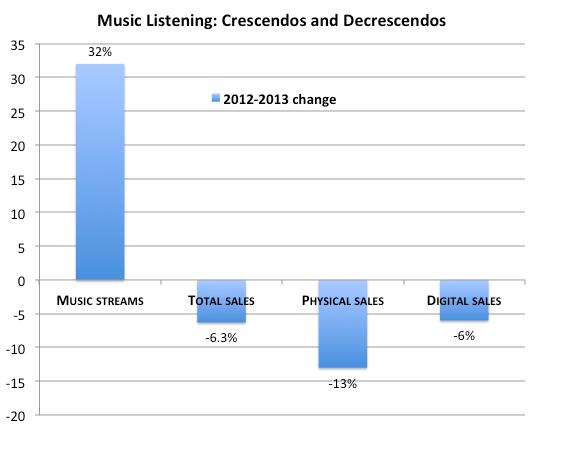
The landscape of the music industry has shifted considerably due to one main factor. The wonder, or nightmare rather, that is online music streaming. The music business body, the British Phonographic Industry (BPI) has recently reported that Britons streamed 14.8bn tracks in 2014, twice the figure of 7.5bn in 2013, as internet connectivity becomes more reliable and more engrained into our everyday lives.

To put a positive spin on it though, things could definitely be worse. With some historical context shed on the situation, we can see that the music industry has definitely seen worse days. In the 1920’s and the 1930’s, the arrival of free music ultimately led to the industry downsizing to a mere 5% of its previous stature and size. This reduction lasted for two whole decades until the 1940’s when the jukebox made a firm and game-altering appearance, in which people were invited to pay to hear music again.

It is needless to say music has come a long way since the invention of the jukebox…or has it? People are still creating playlists, and lining up their tracks, only difference is that now it is all occurs online. This time though, instead of aiding the music industry, it is actually crippling it, almost to the point of an actual break. Online streaming figures have zoomed from zero in 2007 to £76.7m in 2013.

Additionally, thanks to the explosion of YouTube, music labels are raking up millions of extra dollars a month thanks to YouTube advertising. So this additional money being pumped back into the music industry can make up for lack of music sales for the time being. This is why mainstream artists will release, 4, 5 or even 6 singles form each of their albums, each with their own music video. This is good news for video production companies, and for the artists who feel that Spotify and other online streaming platforms are ‘ruining their lives’.

As it turns out, the music industry has been thrown more than one lifeline. As a result of the cost of fuel decreasing, it now costs less to tour, which of course means more profit on ticket sales. The 12 January has marked a five-year low, which is great news for us all, including the touring industry, artists can add more dates to their tour, at a lower cost.

 by Chloe Hashemi

English

The Role Of The Internet In The Music Industry

Dead or alive? That seems to be the main question when it comes to the music industry. The answers vary depending on whom you ask. Consumers would probably say that the music industry is alive and well. In fact, it might be the best time to consume music: you can listen to your favorite artists online whenever and wherever you want for free or at a low price.

Streaming services and radios, such as Spotify or Pandora, are at the peak of their success with Spotify reaching over 50 million subscribers, more than 12 million of which are paid users, and with the percentage of music streaming rising every year. However, you’d get a different answer from artists themselves, who just can’t make a living off such streaming sites, despite their music being listened to by thousands of users.

These two viewpoints distract from a more complex reality. There is no doubt that the Internet has changed the way music is consumed, produced, and distributed. For the artist, streaming and one-song purchases are less profitable than selling entire albums. In fact, quite a few artists have expressed concerns or forthright contempt about services like Spotify. A well-known example of this involved Taylor Swift removing her catalogue from the online streaming site. She did this on the basis that artists do not get their fair share of profits, and she is not alone on this.

Initiatives such as the Content Creators Coalition and Fair Digital Deals Declaration also show that artists feel threatened in the digital age. In response to accusations, Spotify has made their payments more transparent: the service only keeps 30% of their profits and claim that record labels are to blame for short-changing of artists. Another concern comes from David Byrne, who claims that it would be unsustainable for creative work to be funded by digital streaming. Spotify, again, asserts that streaming is more profitable than single track sales, as royalties are paid for every listen. Moreover, they claim their rates to be higher than other services:

music2deal

Despite his critiques, Byrne agrees that music-streaming sites are a great way for new artists to get exposure. They can be found not only by new fans, but also by producers who may get them a record label deal. In this way, the digital revolution has benefited musicians. Traditional record labels can be exploitative and do not allow for much variety. Nowadays, new artists can self-manage through websites like SoundCloud, where the rights to the content and full profits belong to them alone. Subscribing to this view is music producer Steve Albini, for whom the ability to freely share and listen to music is ‘an incredible development’. The British Phonographic Industry goes so far as to claim that streaming actually fuels UK’s music industry growth. Perhaps it’s a bit early to be concerned about online streaming — despite the fact that this way of listening to music is undeniably growing, physical sales remain dominant in the UK.

music2deal2

All this considered, the music industry is really neither alive nor dead, and this Schrodinger’s cat situation is a result of its attempts to adapt to the massive transformations wrought by digitization. Luke Henderson, producer at Fluke Productions, a recording studio in East London puts a positive spin on the situation: “streaming does provide an easily accessible platform for upcoming artists that never previously existed. Indeed it is good to see, in spite of the disarray of the industry the amount of people out there still making half decent music!”

This platform, i.e. streaming websites as a whole have regained some control over consumers, with sites such as Spotify. Which is a cheap and accessible alternative to piracy, and it is trying to regain even more control with Warner Music making a license deal with SoundCloud. There is no way back from these accessible, cheap, or even free ways to listen to music, but a closer collaboration between streaming sites, labels, and artists themselves would appear to be the way forward.

by Chloe Hashemi