English · Interviews

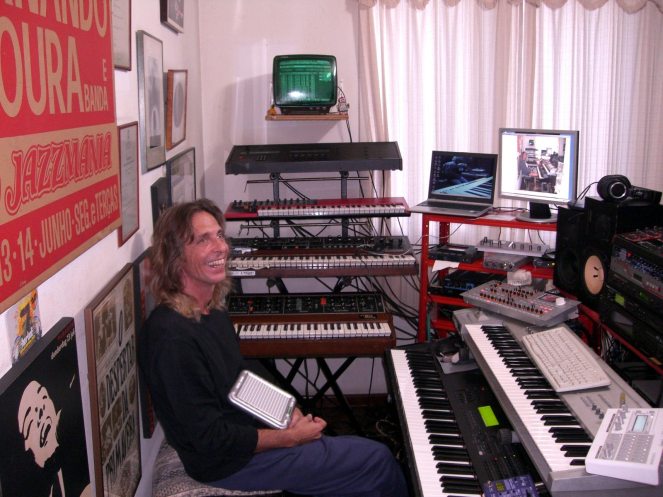
Interview with Fernando Moura

Fernando Moura

Hi Fernando. You are a well-known soundtrack and record producer in Brazil and also a respected instrumentalist. Can you tell us a bit about your history?

I´ve started playing piano at the age of 5 even without a musician in my family. My father used to hear bossa nova and jazz Lps at home all the time. Cesar Camargo and Oscar Peterson. At the primary school, my teachers were so impressed with my performances in front of the small children´s school band that they´ve recommended me to a local piano teacher. From there, I went to Brazilian Music Conservatory where everything was fine until seduced by the composition appeal I was censured by my teachers while improvising new melodies in top of Chopin´s Preludes harmonies at those grand pianos that were a real musical trip during my musical adolescence.

Through Keith Emerson, Rick Wakeman and Jon Lord I could see a connection between classical music and rock at the same time that discovering Miles Davis´ Kind of Blue at American Consulate Library was a revelation for me.

I´ve started to study functional harmony with H.J Koellreuter, composition with Guilherme Vaz, a brazilian soundtrack pioneer of the 60`s and jazz improvisation with American pianist Joanne Brackeen in New York.

As a professional musician and arranger during the 80´s and 90´s I´ve worked both live and in studio with many Brazilian popular artists such as Moraes Moreira, Zé Ramalho, Francis Hime, Marisa Monte, Elba Ramalho and also with foreigners such as Steve Hackett (from English band Genesis) George Martin and Chuck Berry when they´ve visited Brazil.

At this time, I´ve started to collect hours of experience at different studios dealing with a large range of gear from Ampex three channel analog machines, then to 8, 16, 24 track analog recorders, ADATS and started to follow Midi and digital recording technology since my first Atari ST.

From 1995 thru 1997, I´ve studied music for cinema, tv and multimedia in Britain and when I came back to Brazil, I went deep in the instrumental and authorial music world beside building a career as soundtrack composer and producer.

Since 1998 I´ve been working with Japanese artists with much collaboration in records and CDs released there. More details at MySpace (https://myspace.com/fernandomoura).

At the moment my authorial efforts are concentrated mainly on “CosmeDamião” an acoustic piano and percussion duo with percussionist Ary Dias (http://www.youtube.com/watch?v=VS_inlCiYUk&feature=player_embedded). Brazilian music from many different sources is combined with organic grooves, lush harmonies and soundtrack moods opening spaces to improvised and written music. Please check it out at: (https://soundcloud.com/fernandomoura59/afro-bebe-bonus-orch). Playing live in Brasil we are experiencing warm reactions to this live and organic music which makes a perfect balance for my studio work.

Regarding your musical work, what do you have to offer to other members of M2D that is unique?

More than thirty years of experience and still technically updated and aesthetically refreshed. I travel to Japan to work there at least once a year and also take part at events like AES annual Convention and Producer Live Sessions (England) where exchanging ideas in person with artists from all over the world give me a willing to experiment which I think it is the artist´s food. Music today is very much about been capable of quickly produce original options to satisfy the increasing demands of the clients.

The Web brings to us a fascinating possibility of collaborate and interact with artists around the globe but sometimes I feel that some people are more likely to sell their products than to buy or to exchange. My point is to improve artists´ collaborations thru Music2Deal where each one can bring his or her best to the party and this way make it unique and profitable.

Let´s take a simple situation: a soundtrack for a corporate video for a sporting goods company talking about the World Cup or Olympic Games in Rio de Janeiro. As a real carioca (born in Rio) musician I can provide authentic rhythm tracks performed by some of the best Brazilian players and lush piano harmonies that can be combined for example to English guitar solos, Japanese rhythm programming, American brass sections or soloists, African rappers… Endless combinations and possibilities. I do feel that Music2Deal members should think about this type of interacting because this is clearly the future for independent musicians, instead of trying everything alone by themselves. Let´s face it: no one is good enough to be the best option at all duties in the musical process. Also the world is already full of “ jack of all trades”  locked at small rooms in front of a computer screen dreaming to be invited to make soundtrack to Hollywood films or to write the next R&B hit! Collaborating and listening to other musicians is a much more effective way of being successful and happy with your music these days.

What led you to participate in Music2Deal? What do you see as the platform´s differential?

I would like to thank my friend and multi talented sound engineer Rodrigo Castro Lopes’ for inviting me to know about Music2Deal. We recently did a great job recording a CD for legendary Brazilian guitar player Lanny Gordin (http://youtu.be/rSFWE02U2-s) where I did the arrangements, played acoustic piano and keyboards while he recorded and mixed the whole album and live shows. I feel that Music2Deal as a very promising association of musicians because it selects its proponents by the demonstration of expertise in the professional world of music. This can make a whole difference because the Web is already crowded by many offering cheap or even “free” music that has no quality at all or are unable to deliver some outlandish promises advertised just because there are no income guaranteed success in the music business. “How to´s” are generally a better incoming to people who sell books about being successful, but you seldom see a respectable musician or producer giving “success recipes” just because this is an illusion. No one knows how the audience will react to any kind of music product. No marketing plan or huge amount of advertising can assure a real success.

Creative work and collaboration can be rewarding and I do hope that Music2Deal will inspire and help to connect musicians all over the world to keep their independence and creativity at high levels.

Feel free to contact me at fernandomoura@terra.com.br

by Sara Shirazi

English · Interviews

Music2Deal – Interview with Dennis Makhari (Ambassador)

We take the needs of our members at heart and although Music2Deal runs on a technological platform, we form and keep close relationships with our members, whether it be an artist, a publisher or any other music industry professional.

We decided to introduce our first appointed Music2Deal Ambassador by means of a video interview, since it creates credibility and enthusiasm amongst current and future members.   There is no better testimonial but to see and hear what Music2Deal is doing for all players in the music industry, but to hear it from the horse’s mouth.

About Dennis Makhari

As with many songwriters, Dennis holds a steady position as a management consultant in the corporate business world.  However his passion for writing music and as an entrepreneur with a vision, Dennis realized the importance of networking and joined Music2Deal in December 2011.  He has been a supportive and very active member of Music2Deal, ensuring that he builds the necessary contacts in the music industry through Music2Deal to bring his songwriting and music production visions to fruition.

Dennis has an extremely wide and diverse taste in music, from R&B right through to the likes of Pink Floyd and is currently writing songs for his next album project.  Dennis’s immediate future plan is to put together a band that can provide an authentic live musical experience, as he states “we want to connect with our audience in a way that is unrestricted by a specific genre”.

Interviews

Interview with Debbie Cavalier, Vice President Online Learning & Continuing Education/CEO Berklee Online,

Debbie Cavalier Berklee Online CEO

Please tell us about Berklee Online, its history and its mission.

For over 65 years, Berklee College of Music has evolved to support its belief that the best way to prepare students for careers in music is through the study and practice of contemporary music. With a diverse student body representing over 130 countries and a music industry “who’s who” of alumni and faculty that have received 229 Grammy Awards, Berklee is the world’s premier learning lab for the music of today – and tomorrow.

Berklee Online is the online continuing education division of Berklee College of Music, delivering access to Berklee’s acclaimed curriculum from anywhere in the world. Berklee Online’s award-winning online courses and multi-course certificate programs are accredited and taught by the college’s world-renowned faculty, providing lifelong learning opportunities to people interested in music and working in the music industry.

How does Berklee prepare their students for careers in music?

The mission of Berklee College of Music is to educate, train, and develop students to excel in music as a career. Developing the musicianship of all our students is the foundation of our curriculum. We believe that the lessons and qualities derived from that work—the self-discipline needed for excellence, the empathy required of music making and the openness and inquisitiveness essential to creativity—are critical to achievement in any pursuit, musical or otherwise; and that music is a powerful catalyst for personal growth, which is central to any collegiate experience.

Founded on jazz and popular music rooted in the African cultural diaspora, our comprehensive curriculum is distinctly contemporary in its content and approach, and embraces the principal musical movements of our time. Through a course of scholarly and practical learning experiences integrating performance and writing, our curriculum covers the variety of influential styles, relevant technologies, and career opportunities open to today’s music professional.

The Berklee College of Music is famous all over the world; is it also active outside of the U.S.?

Yes. Our online and on campus programs typically have a 30% international population. Berklee Online has documented students from more than 141 countries.

Berklee offers much more than just learning musical instruments. What makes Berklee so unique?

Berklee Online offers more than 200 New England Association of Schools and Colleges (NEASC)-accredited courses and certificate programs in the major areas of Music Business, Theory, Harmony, Ear Training, Arranging/Orchestration, Performance, Music Production, and Songwriting. In addition, Berklee Online has been acknowledged for quality, having been awarded the University and Professional Continuing Education Association (UPCEA) Award for Best Online Course at the college level for an unprecedented eight years in a row. In 2013, UPCEA offered a new award category for Excellence in Online Teaching, and Berklee Online  Production Instructor Loudon Stearns won this award.

When did Berklee start offering courses online?

Berklee has always been at the forefront of distance learning. In the 1960s, there was the Berklee Correspondence course with 26 lessons and assignments sent between students and faculty via US Mail. In 2002, Berklee Online was established as the first fully online music education program. Berklee Online currently teaches over 200 courses and multi-course certificate programs to 13,000 continuing education students per year. In the fall of 2014, Berklee will launch its first ever fully online degrees: Bachelor of Professional Studies in two majors initially, Music Business and Music Production.

What are the benefits of studying with Berklee Online?

Online learning makes Berklee’s faculty and curriculum available to a much wider audience—especially people for whom coming to Boston for four years isn’t possible. Students can stay in the home they live in, in the country they live in, in the job they’re in, and learn at a time that’s convenient for them. Whatever their life circumstances are, this allows them more control over their education.  These benefits extend to the faculty as well. Last spring, Berklee Online Jazz Improvisation instructor, Gary Burton was touring with Chick Corea and was able to to teach his online course from all over Europe, week after week.

Proponents of online education say that today’s students have developed the social skills necessary to form meaningful communities online. Berklee Online Music Business Instructor, Mike King says, “I’ve found that the students often form lasting bonds. In fact, the Internet marketing company Passion Fire Media was formed after its founders, Daniel McCormick and Steve Lenard, met in a Berklee Online class.

Is it possible to combine courses at the physical college with the online courses?

There are all kinds of models out there where classrooms are flipped, blended, or fully online. Berklee Online is the online continuing education division of Berklee College of Music. If a Berklee Online student wanted to take courses—online or face-to-face—at the Boston campus, he or she would have to apply and be accepted to the college. Specifics about transferrable courses can be found on the Berklee.edu Web site.

What training methods or study aids do you use? Can the high standard for which Berklee College of Music is renowned also be achieved online? Do you use different audio-visual material or video content?

Berklee Online spent the past eleven years developing courses and refining educational software tools that deliver the Berklee Continuing Education curriculum online.

The scope and learning outcomes for our online courses are all very much the same as a traditional face-to-face environment, but the path to get there is quite different. Berklee Online courses are media rich, filled with text, interactions, movies, audio files, etc. Over the course of 12 weeks, Berklee Online students work through the lesson material each week. They post questions, upload assignments, listen to and critique each other’s work, answer questions, interact with their instructor, receive feedback on their weekly assignments from their instructor, and participate in a weekly class meeting online. The class community becomes a vibrant online learning environment with lots of communication and musical exchange. Students who are new to Berklee Online are often surprised by how much they learn, how rigorous the Berklee Online online courses are, and how connected they feel to their classmates and instructor throughout the 12-week term.

We’ve structured our online courses to address many different learning modalities. Text, audio, video, live chat, discussion board activities, interactions and hands-on projects are all provided throughout the lessons to help students gain knowledge through their preferred learning style.

Can you get a degree at Berklee Online and how does this work?

Berklee Online’s inaugural class for the new Bachelor of Professional Studies degree will matriculate in the fall of 2014. Applications will be accepted in the fall of 2013. Berklee Online will be offering two majors initially for the degree program: Music Business and Music Production. More information about our new online degree program can be found here: http://online.berklee.edu/degrees

What else does Berklee offer its students?

Berklee provides many options for students online as well as on campus in Boston and in Valencia, Spain. There are Bachelors and Masters programs, online certificate programs, summer programs, free MOOCs (Massive Open Online Courses) through Coursera and soon to be edX. We also have free lessons available through our Berklee Shares Web site. Below are some links to more information:

Berklee College of Music, Boston, US

Berklee College of Music, Valencia, Spain

Berklee Summer Programs

Berklee Online

SNHU/Berklee Music Business MBA

Coursera.org/Berklee

Berklee Shares

What are Berklee’s plans for the future?

To continue to expand the reach of the college and provide ever expanding music education opportunities to a global base of aspiring musicians.

by Sara Shirazi