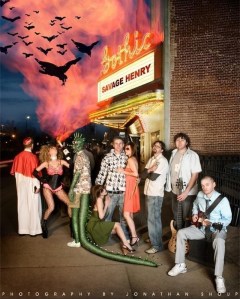
“We were on tour in the Midwest USA in summer 2009. The guys decided to go get some breakfast and mess around town that day, do some shopping. The driver of the bus missed his exit on the highway, needed to get turned around, switched lanes and didn’t see this HUGE Fed Ex truck in the other lane and well, bam!” When Hal Jester, Manager of ‘Savage Henry’, talks about this sad day, he still can’t believe what happened. This is when the song “300 Miles” was written, which deals with the guy’s experiences on the road over the years. “The video picks up where this story left off and the aftermath. The first minute of the video features real news footage. The guys were all OK except for some bumps and bruises but the driver of the bus was injured severely and had to stay in the hospital for a couple of weeks. We felt very bad about the incident.”
Savage Henry was formed in Denver, CO, July 2004. They released their first full length recording of fourteen songs, All In, at the legendary Red Rocks Amphitheater in August 2005. Named Band to Watch in 2005 by Xposure Magazine, they have performed over a hundred live shows for fans throughout Colorado, Nebraska, Iowa, South Dakota, Wyoming and Minnesota and have been featured on Colorado radio stations including 93.3 KTCL and 99.5 The Mountain. The CD, All In and Step Lively, can be found on several major music services including iTunes, Amazon, and CDBaby. Savage Henry immediately gained regional respect with their 2005 debut effort All In, an audio journal of the complexities of relationships pushing against the tide of temptation and self-realization. All In was recognized as one the year’s most skillfully played and cleanly produced albums by Denver’s alternative weekly publication, Westword.
By the end of 2006, Savage Henry picked up a nomination for a Westword Music Showcase Award in the Best Rock category, and then again in 2007, this time in the Best Pop category alongside recent Atlantic signing, Meese.
The members of Savage Henry understand that success in the music industry is more than just skillful albums and blistering live performances, so Savage Henry is an efficient business machine. Stuart Miller is a career guitar player living music through performing, teaching, and publishing placements, and is highly esteemed for his session work. In addition to maintaining the band’s website and promotion online, bassist John Jeffers has earned praise for his skills in sound engineering and recording. Singer Damon Guerrasio’s background in theater brings a unique, one of a kind performance, keeping the crowds rolling in. As a part of the successful “On Second Thought” (until their demise in 2004), Guerrasio has reached his artistic pinnacle as the intricate lyricist and eccentric frontman of Savage Henry. With regular touring, festival, and showcase performances, along with highly acclaimed Pink Floyd tribute shows (Wish We Were Floyd), Savage Henry continues to prove itself as an independent musical success. As shows regularly sell out in Colorado, Savage Henry has also developed sizeable followings in Nebraska, Minnesota, South Dakota and Wyoming.
The band will consider any offers for licensing, record label interest and especially radio airplay on any station across the world. Savage Henry has two excellent CD’s with great packaging and presentation and digital distribution in place.
“However we have no hard copy distribution in place at this time, so that’s something the band may need help with. We need help paying for our hard copy CD’s which are complete with a great package. We were hoping to start selling on the radio. People would buy our tunes online then from those sales we could order more hard copies but we still don’t have a way to get them in Target and Walmart and other retailers. A matter of fact the band was offered a “trial run” 3 years ago from Universal Records. They wanted 1,000 CD’s up front from us to distribute to a few Target stores to see how we would sell. We didn’t have the funds to purchase that many CD’s. So you can see that we have the talent and “big” labels have showed their interest in this band…just bad timing or the wrong type of offer.”
– Hal Jester
Savage Henry on Music2Deal: http://bit.ly/QZLjaZ
Savage Henry on Reverbnation: www.reverbnation.com/savagehenry

 The Music2Deal Blog