English · This & That · Tips

How To…Export Tracks From Garageband

Hello, David Jones from http://www.mixasylum.co.uk again with a blog not about production tips today, but a process that people perhaps take from granted, but for some can be a challenging aspect of getting their tracks professionally mixed or mastered. I would like to explain the export process of Garageband.

This problem came up with a client I was working with this week, so I thought, “why don’t I try to help fellow readers in a similar situation?”  For this example, I am using Garageband ’09. So, let’s get started shall we?

How to export individual tracks from Garageband

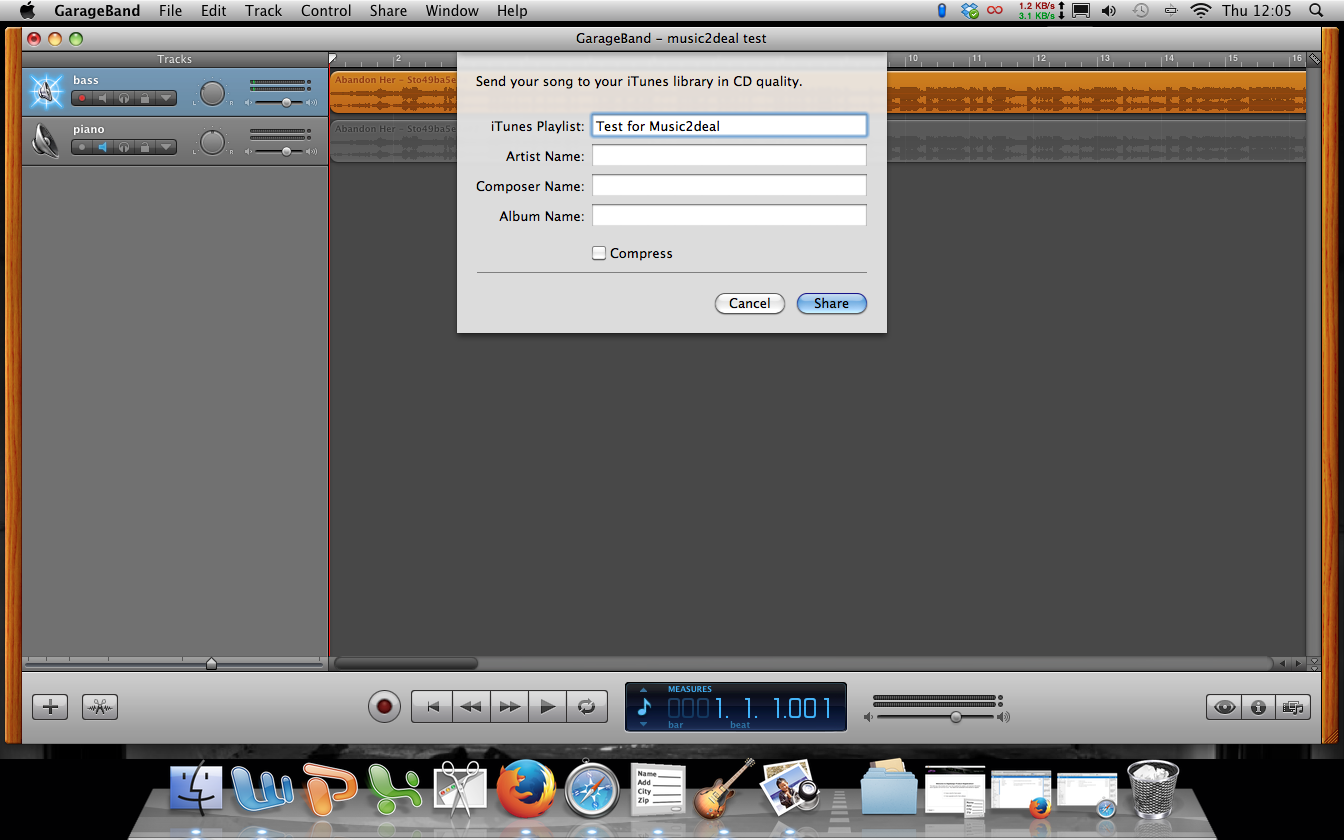
1. In the window with all your tracks, press the speaker icon on all of the tracks you want to mute. This will ensure only the file you want is heard in the bounce. The track that will be hard turns an orange colour, the tracks which won’t be heard turn grey.

bild1

2. To export your soloed track, press ‘Share’ and then select ‘Send Song to iTunes’ from the top Garageband menu.

bild23.     A menu pops up where you can name your playlist (and other details) where the file will go in iTunes. Press Share, and the track begins to export

bild3

PLEASE NOTE that this is only a playlist where all the tracks will be held from this session, which means you can’t name individual tracks yet.

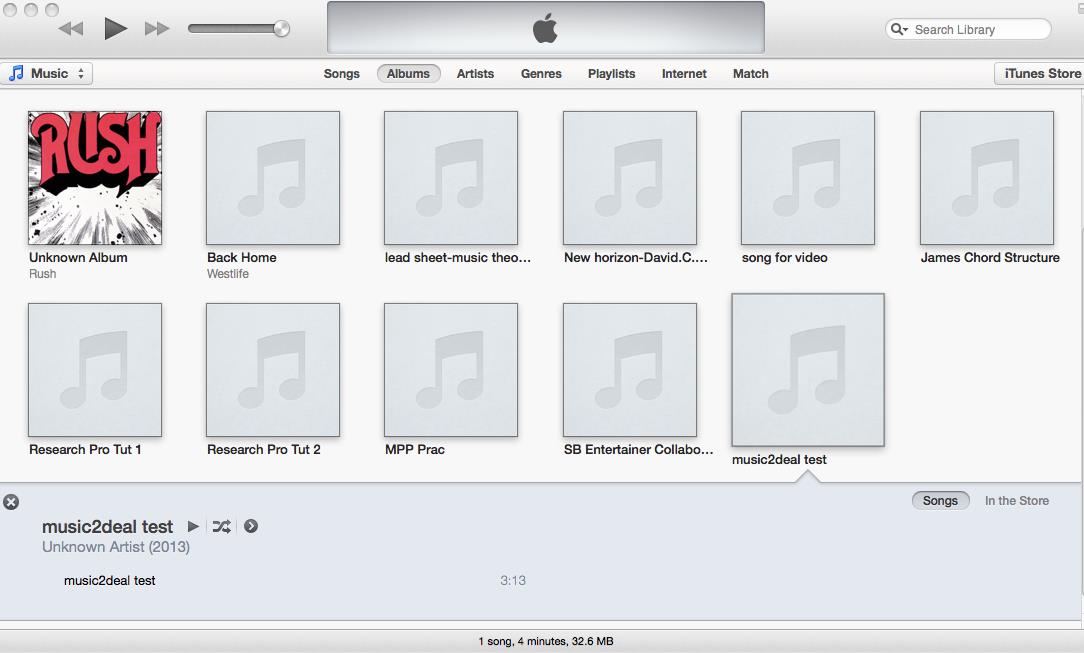
4.   iTunes now appears, so scroll down until you find your playlist name.

bild45. Click on the playlist, and it will open, showing the track(s) that have just been bounced. As you can see, the track defaults to the same name as the playlist. It is best to rename your tracks as you bounce them, as you would probably get confused with 20 tracks all called the same thing!

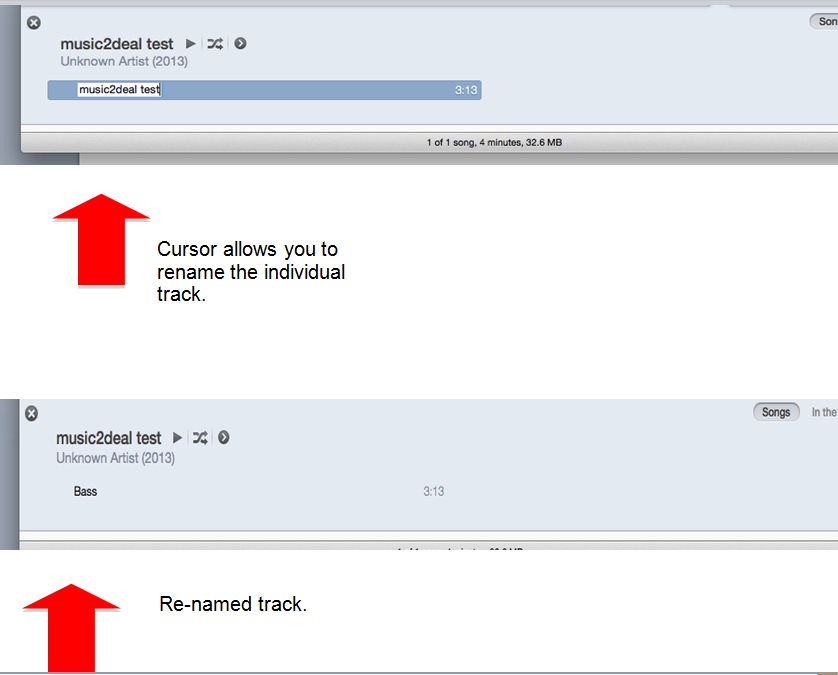
bild56. Click on the name of the track until a cursor appears. This lets you be able to change the name of the individual track. When you’ve renamed it, press enter on your keyboard.

bild6

7. Repeat the above steps until all of your individual tracks are in the iTunes playlist.

8. Job done!

The final word

I know this process may seem like sucking eggs to some, but I just want to help out people who are just starting out in production be able to find their feet so that they are able to hear their own compositions as a professional .AIF file for the first time. I remember when I did my first bounce and heard my compositions for the first time; it was a joyous feeling knowing my tracks had portability for the first time.

If you want to discuss anything about this blog, please feel free to get in touch with me via email at:

techniques-mixasylum@hotmail.co.uk or send a message through my facebook page at: http://www.facebook.com/mixasylum

Any feedback is appreciated, good or bad, or if you’ve got personal tips on the exporting process of Garageband, then I’d love to hear from you.

Thanks, look out for my next blog!

David Jones

http://www.mixasylum.co.uk

English · This & That

Mix Asylum is offering free mixing and mastering services for Music2Deal users

mixasylum

Music2Deal is happy to bring a great opportunity to all artists looking to get their music professionally mixed and mastered free of charge for limited time only!

Mix Asylum is a new, online, mixing, mastering and production venture with the emphasis on affordable work for bands/artists.

Founder and Music2Deal user David Jones, is a newly qualified graduate, gaining a 2:1 in BSc Honours in Music Technology and Production.
“My sole purpose is to help bands/artists achieve their potential without costing them a fortune.”

Having a soundproofed and fully equipped, industry standard studio using some of the best software including Logic Pro, Universal Audio, IK Multimedia and Slate Digital to name a few he can provide you with top quality mixing and mastering services.

As a Music2Deal user you can get your FREE mix (until 31st January) by contacting David via www.mixasylum.co.uk / info@mixasylum.co.uk

Q&A

Why Mix Asylum?

I have only just started my studio and need to increase my portfolio. I know there is a lot of competition but want to prove my dedication and passion to the industry. I also want to help new singers/bands/artists to get a professional/industry sound without costing them a fortune.

What can our users/customers expect?

I am currently offering a FREE service (until 31st January 2014) of:

3 FREE Mastering of songs

AND 1 FREE Mix of a recording

AND 2 HALF PRICE Mixes

Mixes can take anything up to 4 days depending on the amount of tracks involved hence only one song for free!

Could you tell us bit about your experience and equipment / studio?

My Experience:

I gained a Distinction (across the board of 18 subjects) on my college course of BTEC National Diploma in Music Technology Level 3 (2008-2010).

I have just been awarded a 2:1 University Degree in BSc Honours in Music Technology and Production (2010-2013).

During the University course, my final assessment was creating a music recording portfolio, where 6 recordings had to be made in 6 different genres, and I had to organise all of the bands/studio recording time at the University myself (as well as the 30+ other students!). It was high pressured, but it was a good learning curve for me, to get the hands-on experience of a true working studio. I completed the portfolio and obtained a ‘first’ classification (75%).

As part of a final year unit about the wider entertainment industry, the task was to interview people who do a similar job as to what the student wished to do after graduation (so this could have been session musicians, software developers etc) but I wanted to interview producers who have inspired my feelings of a great “sound” on recordings over the course of my music exposure. I was blessed to personally arrange and conduct interviews with:

             Terry Brown (Rush, Cutting Crew)

             Keith Olsen (Whitesnake, Scorpions, Top Gun Soundtrack)

             Tony Platt (AC/DC, Foreigner, Gary Moore, Dio)

             Michael James Jackson (Kiss, Hurricane, LA Guns)

Every one of these interviews was an incredibly humbling experience, and was fascinating learning about their start-ups in the industry. I think they all subconsciously inspired me in my desire to succeed with my own studio, as all of these people had to work hard in their studio, so why can’t I in theory?

I have recently been working with and recording a band (Abandon Her), samples of which can be found on my Soundcloud site and my Music2Deal profile.

My equipment/studio:

Equipment:

I use an iMac Snow Leopard10.6 with Adam A7x as my primary monitors and Sony CMT-MX550i’s as secondary monitors. My main production software is Logic Pro9 but I also have a MacBook Pro with ProTools, Cubase, Reason etc.

I have Universal Audio – UA-2 Duo Custom featuring many top analogue  plug-ins including:

Ampex ATR 102 Tape Machine

Lexicon 224 Digital Reverb

Fairchild Compressor

Neve 88RS Channel Strip

I have many more professional plug-ins including:

Line 6 – Professional Amplifier emulation giving access to 100s of classic guitar and bass amplifiers.

EastWest – Professional industry MIDI Emulation

Symphonic Orchestra

Gypsy (Emulating Spanish/Middle Eastern Instruments)

Ministry of Rock (Emulating Rock guitars, drum kits)

          Fab Four (Emulating instruments with a 60’s production vibe)

For full details please see my website (http://www.mixasylum.co.uk/equipment-page/4578584468).

Studio

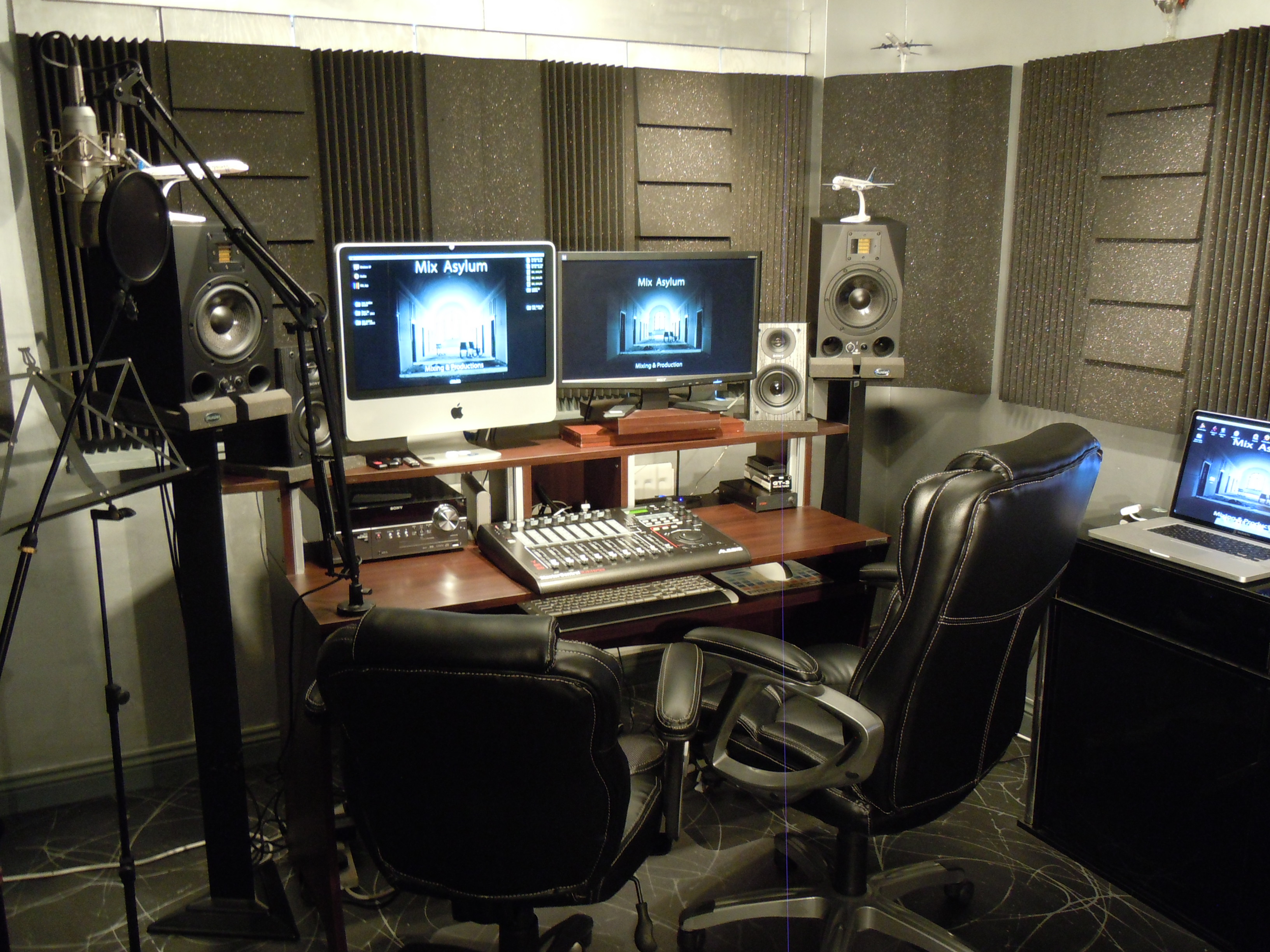
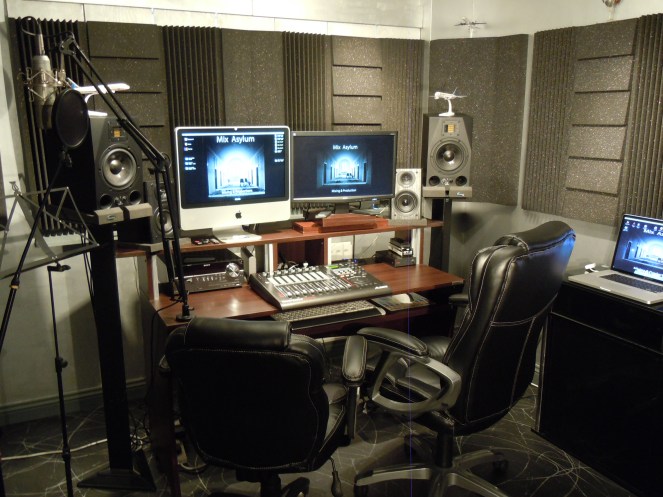
“Mix Asylum” is the name of my production studio, based in Tamworth (near Birmingham) in the UK. It is a home production studio, but a lot of time and effort has been made to professionally change the space into a working studio. For example, it has been acoustically treated with professional foam panels to stop all reflections from emanating in the space, and these are covered all over the studio. The floor has also been acoustically treated so that there are no build up of bass frequencies in the space. What you hear from the monitors is exactly what you get, so someone recording here has got a professional recording space for a fraction of the price of commercial studios.

For photos, please see my website (http://www.mixasylum.co.uk/studio-pictures/4578590366)

Where can users listen to some of your previous work?

People can listen to examples of my mixing work on my soundcloud page http://www.soundcloud.com/mix-asylum. I’ve tried to do songs with as much variety as possible so that you can see I am a versatile mixing engineer. I also have a small selection on my Music2Deal profile.

If you like what you hear and would like to take advantage of my FREE offer,I have my own wetransfer page, a site that allows FREE, secure transfer of files, so there is no need to post me a CD, memory stick etc. This can be reached at http://www.mixasylum.wetransfer.com and step by step instructions of how to use this page can be found on my website at: http://www.mixasylum.co.uk/sending-your-files/4578999871


English · Tips

Music Industry Changes

Allen_20JohnstonArticle by Allen Johnston

Today’s music business is heading rapidly toward entertainment industry structural changes, the laws and regulations we use for our everyday business are morphing into a totally new set.  Greater interest in direct digital licensing among publishers, efforts to establish Pan-European licensing and the creation of a global repertoire database are reshaping the landscape being navigated by Writers, Publishers and  Performing Rights Organizations (ASCAP, BMI, SESAC, etc…) worldwide

Outlets, businesses, independent labels and some major labels are not renewing their digital agreements with the performing Rights Organizations (ASCAP, BMI, SESAC, etc…)  A number of large digital music users, including Clear Channel, Entercom and Sirius XM, have negotiated direct licenses with various music labels in an effort to lower the rates that these services pay for music royalties. Future changes in the entertainment industry will include PRO (Performing Rights Organizations) having smaller revenue bases and possibly charging higher percentage rates or even dedicated service charges.

For in-store business music services (also called background music services, or business establishment services), one of the largest companies negotiated a direct deal with one of the largest music publishers – and the negotiated prices eventually were found by rate courts to be the best evidence of the market price, which were used to set the price that ALL players in the market pay to ASCAP and BMI.

We once thought that Regardless of what happens in the digital market, PROs will always have general performance licensing to fall back on because monitoring song plays at bars, clubs and stores requires boots on the ground to track.  Technology is changing that concept by monitoring on line streaming events, “live” and recorded shows and the design of tracking software for cloud storage of music & video files.

New online services now enable the music industry to do business (as never before) by providing the searching, previewing,  license pricing, contracts, invoices and download access needed to foster efficient, professional relationships between the music creators and the industry people needing to license their tracks for an unlimited variety of commercial media projects.

The new music industry has been ushered in with a swift change of leadership and direction.  Many foolish people still hold on to ancient concepts and believe that the Black radio & record community will revive itself.  This is NOT going to happen, for everything must change.  My generation made the music industry an industry of “smoke & mirrors” where companies and individuals were paying thousands of dollars just to tell a LIE about their music.  The reasoning was that a major label would pick them up, pay them and make them a star.  Technology, even though still used to perpetuate LIES, has made several common place entertainment entities completely worthless.

RETAIL PROMOTION – Hiring people that would make sure that your song got Sound Scan reports every week and assist you in “hyping” the charts.  No longer is it necessary for there are no independent records on the charts to be hyped.

RETAIL TRACKING – Seems like there is no one who really cares about where your record is physically or digitally located and what it is doing on a weekly basis.  So there’s no one left who calls retail on a regular rotation.

RADIO PROMOTION – The KING of hype games is still being played but on a much larger, more expensive level.  Today you can pay a promoter $25,000 to $65,000 just to get spins at night, during mix shows and on weekends.  This can get you into the Billboard charts, however you haven’t sold any music and you still have to spend money to have your artist work promotional dates.   For $80,000 – $250,000 you can have your music placed on air (depending on the stations format), BDS (Broadcast Data Service) reported and eventually Billboard charted.  However since NONE of this promotion is truthful you still have to find another way to sell physical and digital product to the masses.

RADIO TRACKING – This was a given job for hundreds of label secretaries and interns, now there are no lists of songs for the station to give out, no one within the station who even makes a decision on music or relationships between the caller and the station.  Independently owned music is not even being played on terrestrial radio under any format except non-commercial.

VIDEO PROMOTION – Who tracks your video plays, has the relationship with the major video television companies or even owns a list of the available television programs to send your video to?  Of course there is You Tube and multiple online outlets, but who knows that your video is on You Tube?

RECORD POOLS – When DJ’s were playing records, then you needed someone who knew the most popular club DJ’s and could get your music to them PLUS get feedback on your tune.  The advent of MP3 technology coupled with the shady, money hungry actions of Record Pool Directors has made this type of company totally unreliable and unnecessary.   The reasoning behind even having a Record Pool was to give unbiased feedback directly from the “end user” (audience), today your feedback is coming from Facebook, Twitter, Reverb Nation, You Tube, etc..

INDEPENDENT RETAIL STORES – Sure there are still a few stores left in certain neighborhoods around the United States, the biggest transformation is that they are selling music as a sideline.  Their front line business is clothing, drug paraphernalia, household accessories or hair care products.  An extremely few specialty stores are making Sound Scan reports, but most of those can be bought and have no honest relevancy.

BILLBOARD – The Billboard charts were once used as a list for the record retailer to purchase from.  Customers would come in, look over the list, normally posted on a wall or bin, and make their purchases. As a record label you had to chart your record to justify sales, improve airplay and get wholesalers to pay you what they already owed you.  It truly was the bible of the music industry.  No longer is it necessary to “climb” the charts to become a musical success.  The “bible of the industry” has become the “comic book” of the major labels.

INDEPENDENT DISTRIBUTORS – These are the wholesalers that operate as middlemen between the label and the retailer.  Because the chain system (Best But, Target, K-Mart, etc…) now controls the majority of sales of recorded music, these distributors have a much tighter and smaller inventory and some malicious games for the label.  As a label you must pay for distributors’ promotion, marketing, place and positioning within stores, special programs and if your product sits on the wholesalers’ floor more than 30 days you pay for storage.

ONESTOP – a smaller wholesaler that has almost disappeared from the industry landscape, while most were specialty record orientated there inventory was never large. The majority went out of business based on outstanding debts coupled with mobile music trading, purchasing, streaming and video.

I am truly glad for the change that has over taken the music industry.  Today you can own your music completely and sell directly to the consumer without any middlemen.  By the way, for all you old timers that wishes for the good old lying, hyping and buying reports days to come back.  Keep dreaming.