Music2Deal is happy to bring a great opportunity to all artists looking to get their music professionally mixed and mastered free of charge for limited time only!
Mix Asylum is a new, online, mixing, mastering and production venture with the emphasis on affordable work for bands/artists.
Founder and Music2Deal user David Jones, is a newly qualified graduate, gaining a 2:1 in BSc Honours in Music Technology and Production.
“My sole purpose is to help bands/artists achieve their potential without costing them a fortune.”
Having a soundproofed and fully equipped, industry standard studio using some of the best software including Logic Pro, Universal Audio, IK Multimedia and Slate Digital to name a few he can provide you with top quality mixing and mastering services.
As a Music2Deal user you can get your FREE mix (until 31st January) by contacting David via www.mixasylum.co.uk / info@mixasylum.co.uk
Q&A
Why Mix Asylum?
I have only just started my studio and need to increase my portfolio. I know there is a lot of competition but want to prove my dedication and passion to the industry. I also want to help new singers/bands/artists to get a professional/industry sound without costing them a fortune.
What can our users/customers expect?
I am currently offering a FREE service (until 31st January 2014) of:
3 FREE Mastering of songs
AND 1 FREE Mix of a recording
AND 2 HALF PRICE Mixes
Mixes can take anything up to 4 days depending on the amount of tracks involved hence only one song for free!
Could you tell us bit about your experience and equipment / studio?
My Experience:
I gained a Distinction (across the board of 18 subjects) on my college course of BTEC National Diploma in Music Technology Level 3 (2008-2010).
I have just been awarded a 2:1 University Degree in BSc Honours in Music Technology and Production (2010-2013).
During the University course, my final assessment was creating a music recording portfolio, where 6 recordings had to be made in 6 different genres, and I had to organise all of the bands/studio recording time at the University myself (as well as the 30+ other students!). It was high pressured, but it was a good learning curve for me, to get the hands-on experience of a true working studio. I completed the portfolio and obtained a ‘first’ classification (75%).
As part of a final year unit about the wider entertainment industry, the task was to interview people who do a similar job as to what the student wished to do after graduation (so this could have been session musicians, software developers etc) but I wanted to interview producers who have inspired my feelings of a great “sound” on recordings over the course of my music exposure. I was blessed to personally arrange and conduct interviews with:
Terry Brown (Rush, Cutting Crew)
Keith Olsen (Whitesnake, Scorpions, Top Gun Soundtrack)
Tony Platt (AC/DC, Foreigner, Gary Moore, Dio)
Michael James Jackson (Kiss, Hurricane, LA Guns)
Every one of these interviews was an incredibly humbling experience, and was fascinating learning about their start-ups in the industry. I think they all subconsciously inspired me in my desire to succeed with my own studio, as all of these people had to work hard in their studio, so why can’t I in theory?
I have recently been working with and recording a band (Abandon Her), samples of which can be found on my Soundcloud site and my Music2Deal profile.
My equipment/studio:
Equipment:
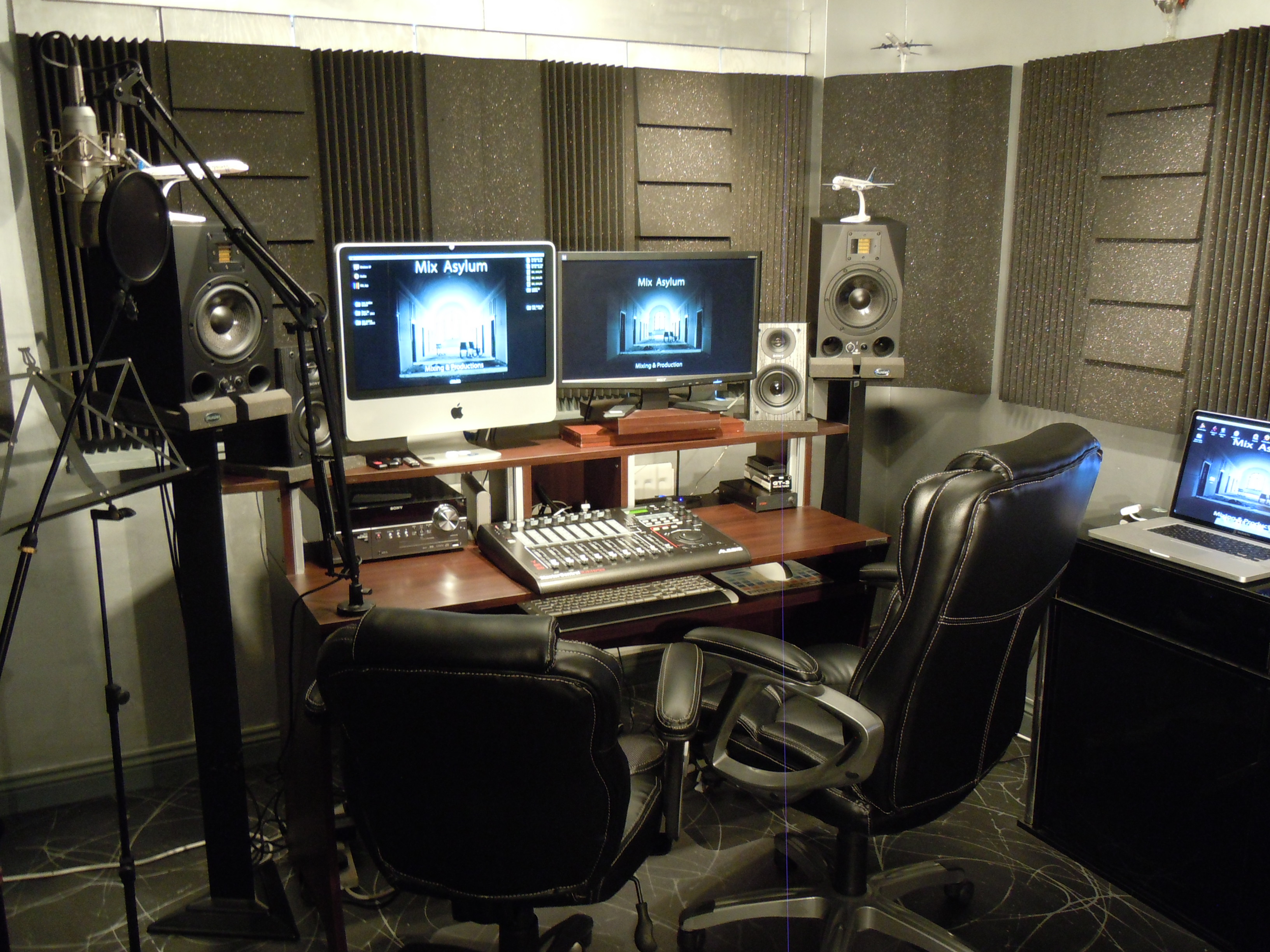
I use an iMac Snow Leopard10.6 with Adam A7x as my primary monitors and Sony CMT-MX550i’s as secondary monitors. My main production software is Logic Pro9 but I also have a MacBook Pro with ProTools, Cubase, Reason etc.
I have Universal Audio – UA-2 Duo Custom featuring many top analogue plug-ins including:
Ampex ATR 102 Tape Machine
Lexicon 224 Digital Reverb
Fairchild Compressor
Neve 88RS Channel Strip
I have many more professional plug-ins including:
Line 6 – Professional Amplifier emulation giving access to 100s of classic guitar and bass amplifiers.
EastWest – Professional industry MIDI Emulation
Symphonic Orchestra
Gypsy (Emulating Spanish/Middle Eastern Instruments)
Ministry of Rock (Emulating Rock guitars, drum kits)
Fab Four (Emulating instruments with a 60’s production vibe)
For full details please see my website (http://www.mixasylum.co.uk/equipment-page/4578584468).
Studio
“Mix Asylum” is the name of my production studio, based in Tamworth (near Birmingham) in the UK. It is a home production studio, but a lot of time and effort has been made to professionally change the space into a working studio. For example, it has been acoustically treated with professional foam panels to stop all reflections from emanating in the space, and these are covered all over the studio. The floor has also been acoustically treated so that there are no build up of bass frequencies in the space. What you hear from the monitors is exactly what you get, so someone recording here has got a professional recording space for a fraction of the price of commercial studios.
For photos, please see my website (http://www.mixasylum.co.uk/studio-pictures/4578590366)
Where can users listen to some of your previous work?
People can listen to examples of my mixing work on my soundcloud page http://www.soundcloud.com/mix-asylum. I’ve tried to do songs with as much variety as possible so that you can see I am a versatile mixing engineer. I also have a small selection on my Music2Deal profile.
If you like what you hear and would like to take advantage of my FREE offer,I have my own wetransfer page, a site that allows FREE, secure transfer of files, so there is no need to post me a CD, memory stick etc. This can be reached at http://www.mixasylum.wetransfer.com and step by step instructions of how to use this page can be found on my website at: http://www.mixasylum.co.uk/sending-your-files/4578999871
 The Music2Deal Blog