This & That

The Cannes Starter Guide – Part 3 (written by Michael Leahy)

What to wear to Cannes

„Michael Leahy is a platinum lyricist that first attended Midem in 1997 tying to pimp digital services to labels. He has since done business development for African labels, marketing for Midem itself and pitched projects at the Cannes Film Festival. He has also coached music and movie people in the fine art of networking. He wrote the Cannes Starter Guide last year as a mind-map for getting results at Midem.”

Cannes Starter Guide small

A quick guide to pitching at Midem

Cannes is pitchville. You do it the whole time, sometimes even unconsciously. If you don’t have experience, it can seem daunting and like sex, there is a danger of having unreasonable expectations. But remember, lacking experience is a problem that is easily fixed (well, in pitching anyway). But Midem can be intense, as people try to maximise their time. Here are a few thoughts for being more comfortable and ultimately more successful when you pitch:

Determine what you want to achieve. In the majority of cases, you won’t physically sell anything at a face-to-face pitch at Cannes. What you are trying to do is to get permission to start actual negotiations at a later stage. You have to make a good impression and get the person to whom you are talking to say, “Cool, let’s talk about this next week. Here’s my card”.

Always start with a one-line account of yourself. “Hi. I’m Michael. I work with [company name], Europe’s biggest/newest/most innovative/latest writer/producer/label/publisher (or whatever). I’m at Cannes this year to check interest for a new [whatever].” Keep it short. Keep it focused. You are talking to this person for one reason, not three. As you have done your homework (hint: use the event database), you can comment on their company’s latest success, release or whatever is relevant. Show them you know their business. By this time, you will be nonchalantly fingering your promo material without really showing it. Hopefully, you will hear the magic words, “So how can I help you?”

Pitch in 25 words or less. The movie business has a wonderful discipline called “25 words or less”. Ultimately, it’s all you need to get some initial interest. If you’re pitching a service or app, start here with the basic premise in 25 words or less. If you’re pitching music, you’ll actually find that many people are not really equipped to listen to music at Midem as it takes a few minutes. Give them a short blast – but know when to switch back to verbal pitching. Never, ever read from a text. You have to be so convinced that your stuff is right for this person that you can keep eye contact at all times, only breaking it to show them some promo material. If you get him or her to nod their head, you can start going deeper into your pitch. In music, labels are mainly interested in indications that a potential audience is out there. From 25 words, you’re into a 10-minute conversation. So far, so good.

Keep the radar on. As you are talking, keep a very close eye on the other person’s body language. Some people are comfortable with stopping you in your tracks if your pitch is not relevant to them. It saves time. Others sit and squirm, wondering why they took this meeting and hoping you can read the signs. If you get a negative vibe or a request to “get to the point”, take the appropriate steps. If it’s negative, ask politely why. Accept that whether they go for your pitch or not, they are probably making the right decision for their situation. You can learn a lot from being brushed off. You’ll find that either your product is a total dud, or that you are selling it badly – which is an important learning. Most people will be grateful you don’t oblige them to become impolite. You might also get great market info such as “We did something similar two years ago and lost money; we found there was no market” or “We’re getting right out of that genre, and here’s why”. Make rejection pay.

Get out of the meeting. As I said, it is vital not to wear out your welcome. If you get a positive response, aim to be out of the meeting on a high note within 3 minutes. Don’t bother with small talk or comments about the view over of the bay. Just get out and look forward to being in touch later. If you got a negative response, thank them for the insights, shake their hand warmly and tell them you might be in touch at some distant future date. But let them understand you won’t be chasing them with this project. Then run around the corner and write down what you learnt. You can review it later back in the office and draw up plans.


These are broad rules. Each of them can be broken, depending on whether you have a relationship with the person you are pitching to and individual circumstances. One other thing that is worth mentioning: if this is your first or second time, a lack of interest might be dispiriting. Remember that some deals are just not worth signing.


As a reminder:

Links:

Cannes Starter Guide: http://amzn.to/1C4H07H

Midem 2015 Cheat Sheet: http://amzn.to/1DUCGp8

Cannes or Bust: First time in Cannes http://cannes-or-bust.com/first-time-in-cannes/

Midem: http://www.midem.com/


Discussions:

https://www.music2deal.com/groups/internationalhangoutlodge/hang_out_introduction/2754

https://www.music2deal.com/groups/mmfgroup/information/2755

https://www.music2deal.com/groups/ambassadors/promotion/2756

https://www.music2deal.com/groups/songwriter/news/2757


German · Tips

How To Prepare To Work With A Music Producer

Brad Chapmen
by Brad Chapman

Brad Chapman has been doing vocal pre-producing for over 35 years, and developed a signature technique for producing FEEL while working with producers and artists such as: Quincy Jones, David Khane and 100+ Grammy winners.


1. Personalized Warm Up Exercises:
Learn how to warm up your voice with exercises specifically for you. Canned warm ups or YouTube warm ups, most likely won’t work well for you (they might even hurt you.) Your warms up should be specifically for you.
Singing songs is an ineffective way to warm up, as you could be tiring out your voice; rather than warming it up. Why do I stress this topic? Being warmed up to your best vocal condition, will keep you from being distracted by your voice and keep your mind on the story line and emotions.
My phrase for this is ‘sing from feel’. Feel the emotion first and then sing them out. If you do cardio and or a steam room, do these before you do your warm ups. Especially if you have an early morning performance.

 
2. Constantly Train And Be Prepared:
Start pre-production now and never stop. You must always be preparing for the right moment. A quote from Grammy winning Jeff Bhasker is: “If you’re not completely ready for me, I won’t produce you”. This is something I hear more and more from seasoned producers. They don’t want to train and develop you. It’s up to the vocal artist to be trained and prepared.
Developing a strong belted-head-voice will keep the producer from having to fight to record your voice due to overloading the pre-amp. (Don’t yell on your high notes.) If producers have to limit the sound, this results in less color in your voice. Also, intimate passages are difficult to record unless you can control the volume dynamics thru belted-head-voice.

 
3. Work With Someone During Vocal Tracking:
Train your voice and ears for the microphone, headphones, floor monitors, and in ear monitors. There is always someone running your sound system or vocal tracking (at least there should be.) I realize that there are a few stories of artists like Prince and Todd Rundgren self-producing. (However, I doubt that they were alone during the vocal tracking.) The reason you want to work with someone during your vocal tracking is that it is quite complicated to engineer and focus on your emotions of the song.
The totally self-produced vocals I’ve heard, lack feel and that’s what the vocal needs the most. Remember always that singing is communication to your fans. Having a producer in the studio helps make sure you are communicating, otherwise you’re
singing to yourself. If you’re producer doesn’t know that, ask him to listen as an audience would and give you feed back. Your vocal expression if far more important than the Sonic’s of the recording.

 
4. Befriend Your Producers:
Become immediate friends with your producers. Get them to like you, so that they care about your performance. (The average producer is like the average audience. If you don’t take care of your electronics, then they assume that you are not a quality singer. If you ’piss them off’, they may actually intentionally create a bad mix, where you can’t hear yourself.). Note: Please refer to Music Connection Magazine, cover page ‘Don’t Piss-Off The Sound Guy: http://www.musicconnection.com/dont-piss-off-the-sound-guy/
Your producer actually can purposely or accidently ruin your voice and your career.
When people hear you sing and you don’t understand the electronics you’re performing through, your audience will blame you for sounding out of tune and strained; and they should blame you. When you can’t hear yourself comfortably with headphones, in ear monitors or stage monitors; you will sound tone deaf and/ or over the top (meaning that you are trying too hard to hear yourself).

 
5. Monitor Feedback Is One Of Your Enemy’s
Buy a small mixer, microphone, head phones and floor monitors and use them every day (even while doing vocal exercises.) Learn about how the equipment works. Then, you can talk intelligently to your producer and make sure the recording studio and the live audience will hear you at your best; and consider you a good to great singer. When you put headphones on at the studio, you must communicate with the engineer/producer in order to make yourself sound great to yourself in the tracking mix.
Have your voice working so well that when the producer, stage or studio, doesn’t need to correct you; or if he does, you can make corrections on the spot. Always test your mic before the music starts. If you start singing with the music and your mic is off, it’s quite embarrassing and again the audience will blame you; not the sound man.

 
6. Feel Your Song’s Story; Ignore Mistakes During The Performance:
Ninety percent (90%) of your singing must have feel. Make sure that your vocal problems do not distract your conscious mind from the feel of the song. Your mind should be at least 90% on the story and how you feel about it.
The producers call this ‘feel’. They will always ask you for more and more feel, and emotional expression. They know that is the only way they can produce a performance
that means something to your fans. If you make a mistake, learn to ignore these and continue singing the song’s story with emotion; and stay in the feel of the music and the story.

 
7. Train Until The Song’s Technique And Emotions Are 2nd Nature:
How is this done? Repeat your song over and over again. You will develop the ability to stay in the story from beginning to end; never being distracted. At the same time, make the story’s emotions the only place you want to live in, as you feel the story.

 
8. Enjoy Your Performance And The Music:
Now, you will have a great time performing live and in the studio, and everyone attending will enjoy your great performance.

 
Brad Chapman Vocal Pre-Producer http://www.bradchapmanvocals.com

This & That

The Cannes Starter Guide – Part 2 (written by Michael Leahy)

What to wear to Cannes

„Michael Leahy is a platinum lyricist that first attended Midem in 1997 tying to pimp digital services to labels. He has since done business development for African labels, marketing for Midem itself and pitched projects at the Cannes Film Festival. He has also coached music and movie people in the fine art of networking. He wrote the Cannes Starter Guide last year as a mind-map for getting results at Midem.”

Making contacts at Midem (or any other event for that matter)

We attend trade fairs basically for two reasons: to meet people and get industry news that will give us an edge. That’s it. Everything else is an add-on. If you think you are not doing enough business, then get out and meet more people. Business comes through people (which is also basically why I hang out on Music2Deal – I still have a great Spanish song to offer if you know someone that needs one).

So how do you go about this in the context of a trade fair? At a basic level, there are three ways of doing business at trade fairs: through people you know; people you know about; and people you don’t even know exist.

  • Trade fairs offer exceptional opportunities to catch up with people you know or might have known. Be sure to let them know you are attending. Has your contact gone cold? This is an opportunity to warm it up a little. That guy you knew that used to book bands in a youth club might be the brand manager of Shure microphones by now, or Luc Besson’s music supervisor. You’ll find that telling them you are attending Midem will make them curious. You might be able to get a meeting with people that are not even attending!
  • Everyone knows the names of a few key players in their field. Trade fairs offer an opportunity to reach out to them. Just make sure you do your homework before contacting the head of Universal Publishing. Run their name through Google News. Check their latest job title on LinkedIn. These things are not difficult to do. Then tailor your message to what they are doing right now. Don’t waste their time. Be courteous and get to the point.
  • There are literally thousands of people that you don’t even know exist doing good business in small niches or territories you had not initially thought about. This is particularly true since the arrival of the digital economy where extra services or apps can create exciting new products. Last year, I saw some sensational new tools for generating income on YouTube and improving merchandising sales at concerts.

So much for the principles. How do you go about grabbing appointments?

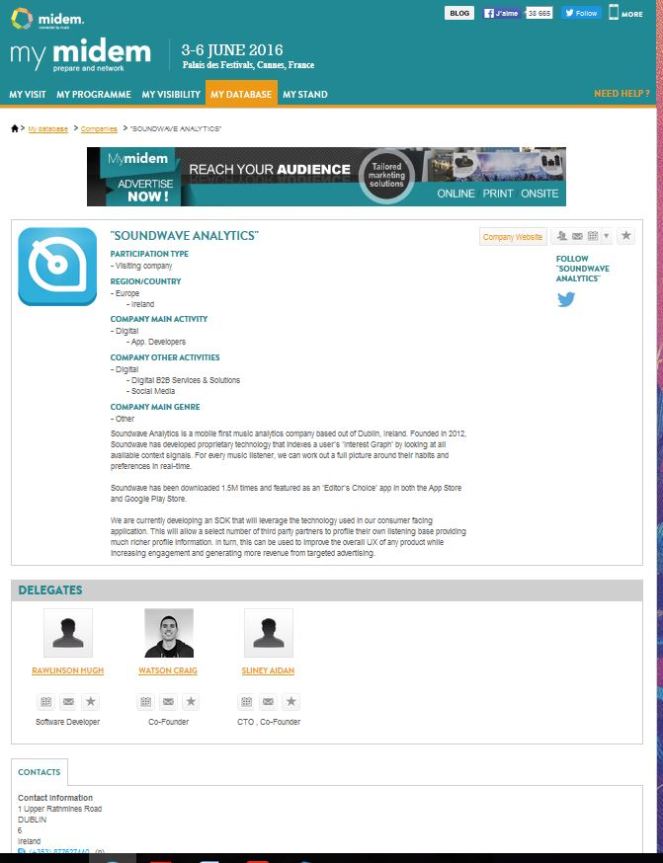
  • Set up your profile in the event database. Very important: specifically mention the key reasons you are attending and who you are looking to contact. Be very clear about this. Some databases now run match-making services that will suggest targeted leads for you. The clearer you are, the better the results. Tip: check and double-check all your e-mail and contact info in the database to ensure it is correct. A guesstimate is that about 5-10% of e-mail addresses or web links don’t actually work. Add all the photos and samples you possible can. Take those extra 10 minutes to present yourself completely. Unless you work for Universal, do not expect people in another country to know what you do. Also, resist the temptation to tick all the boxes in the database. A one-man company without an ID photo that claims to be a DJ/label/music supervisor/distributor/manager/artist is not credible and will be ignored. Sorry.

Database - Soundwave

  • Set up meetings with key people you want to meet at the show. Mine the event database to set up meetings, over and over again. Prioritise. Start by trying to reach key people in key territories, and then work your way down. Keep at it. Tailor each message to each individual. But also leave room for people that might contact you. Are there any media people, show organizers, current or prospective suppliers or perspective employees you want to hook up with? When it comes to actually meeting, would a meeting or a coffee be more appropriate? If you are lucky, you might find yourself booked from 8.30am to 10.30pm. If so, try and group the meetings in the same areas so you don’t have to run from one end of the building to another. Boring tips? Sure: drink lots of water and take lots of notes. You’ll have a hard time remembering what you said ten days from now.

Hopefully, this will bring you your first appointments. As the pre-event e-mails start rolling in from Midem, check them to see if anyone they mention could be useful to you. Then dip into the database to try and set up an appointment.

In the next article, I’ll go over how to pitch and handle yourself in one-on-one meetings. So drop by the Music2Deal blog next week.


As a reminder:

Links:

Cannes Starter Guide: http://amzn.to/1C4H07H

Midem 2015 Cheat Sheet: http://amzn.to/1DUCGp8

Cannes or Bust: First time in Cannes http://cannes-or-bust.com/first-time-in-cannes/

Midem: http://www.midem.com/


Discussions:

https://www.music2deal.com/groups/internationalhangoutlodge/hang_out_introduction/2754

https://www.music2deal.com/groups/mmfgroup/information/2755

https://www.music2deal.com/groups/ambassadors/promotion/2756

https://www.music2deal.com/groups/songwriter/news/2757