English · Tips

Understanding Logic Pro’s “Audio Bin”

Hi everyone,

David Jones from Mix Asylum back again with another production technique you might not be aware of. This doesn’t specifically relate to production, but it is a handy tool to keep track of your audio file management, something I think we could all brush up on.

For my 4th blog entry, I’d like to talk to you about Logic Pro 9’s “Audio Bin” and hopefully share with you some info you may not have realised about it.

What is “Audio Bin”?

Up until about two weeks ago, I could not have answered that question myself, as I had never had cause to use it in my productions before. What I’ve learnt recently is that the Audio Bin is a virtual “store” of all of the audio files used in the particular Logic session you have open, listed in alphabetical order.

Why would I use “Audio Bin”?

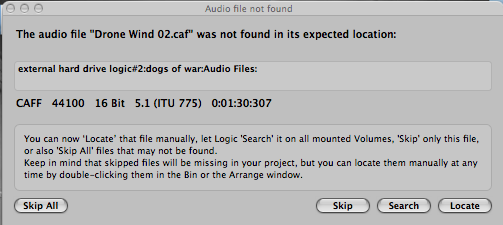
Have you ever had this dialog box open when you first open Logic Pro 9?
1

It can be REALLY annoying when this happens, as a file you may have worked days/weeks/months on can’t be found on your computer, so won’t be featured in your mix. The file may even be located on an external hard drive not connected to the computer, giving you much more hassle than you need. There are two options you can do at this stage:

a) Locate the file yourself from the ‘locate’ button (easier said than done, right?)

2b) Use the ‘Audio Bin’, which has automatically stored a copy of the file in the project window. Bear in mind, there is some locating involved, but this is a much more easier way!

How do I use “Audio Bin”?

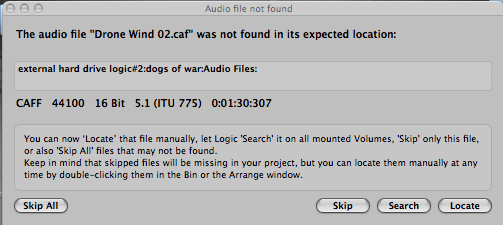
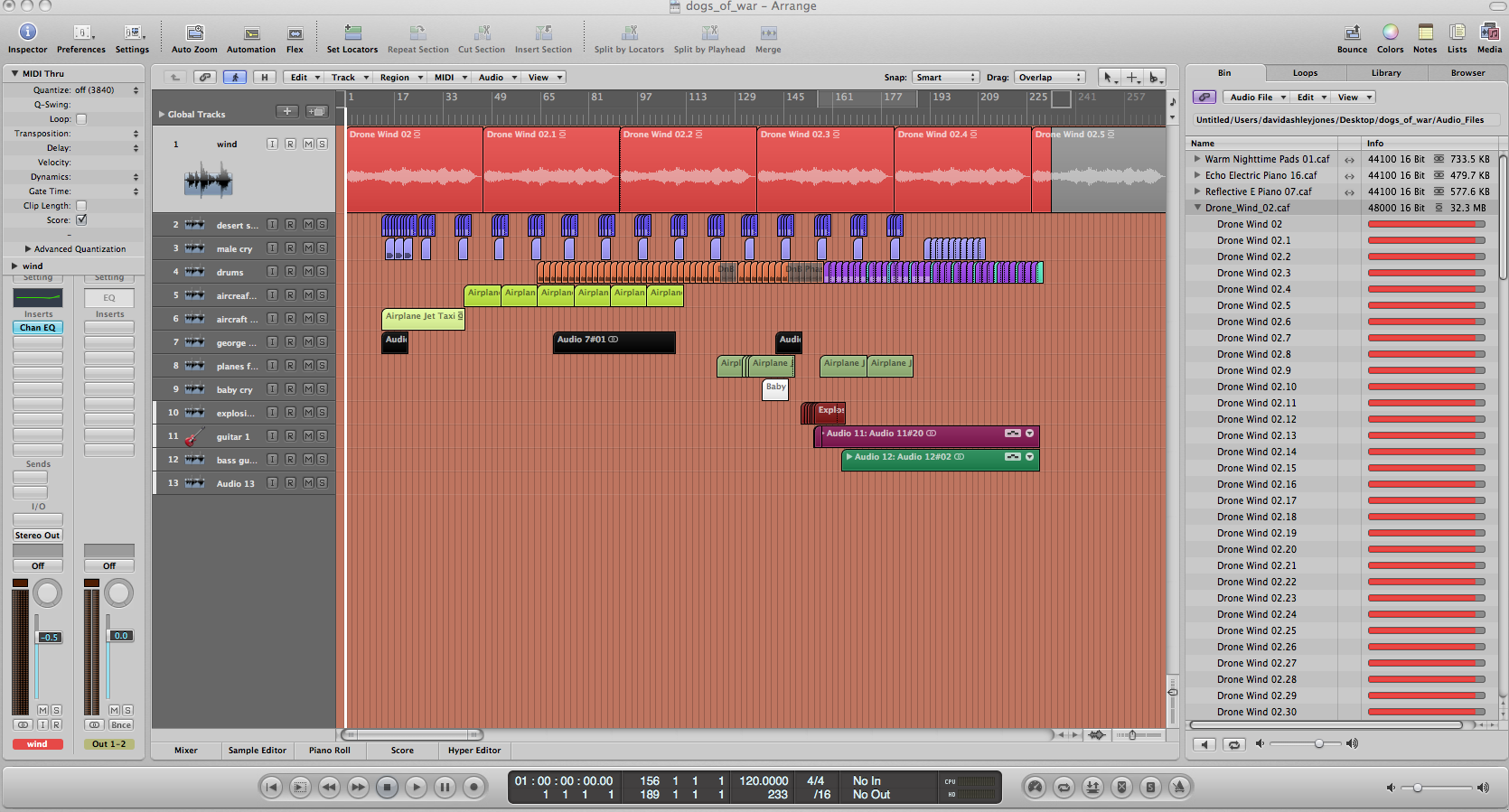
  1. When the “Audio File not found” dialog box appears, press ‘skip all.’ For this example, I am going to locate the “Drone Wind 02.caf”, but this process can be used on all missing files.
3

Your project will then load (with the missing audio files) and look something like this:

4

As you can probably see, the audio file block is exactly where it is supposed to be in the track, but the audio waveform is missing (meaning no sound will play).

2. Press the ‘Media’ tab, which is the fifth item along the far top right of the Logic project:

5

Ordinarily, users are presented with the loops view of the media window:

6

3. Press the ‘Bin’ tab in this menu, where the audio bin is now presented:

7

8

7

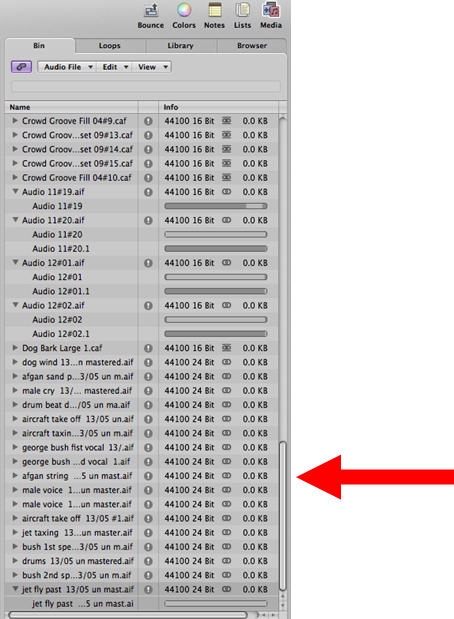
This is the Audio Bin, and from here it lists all of the audio files contained within this project. I am now just using the lever at the side bar until I come across the file I want to locate (“Drone Wind 02.caf”).

4. When you’ve found your missing file, you can choose to open a drop down list which shows you how many times you have used this file in the session (Logic gives each instance a separate name, like Drone Wind 02.1, Drone Wind 02.13 etc).

8

8

5. To return the missing audio file to your project, double-click on the main file name…

9

…and the following dialog box appears:

9

Press ‘Locate’ to begin the process of finding your file.

6. This is where the scouting part begins, but don’t worry, because the Audio Bin has kept this copy of the audio file specifically in the session’s ‘Audio Files’ folder so locating it is very simple.

7. Navigate to where the session file is located on your computer. For this example, I have placed this session                         (called “dogs­_of_war”) onto the desktop. Double-click to open the folder’s contents.

9

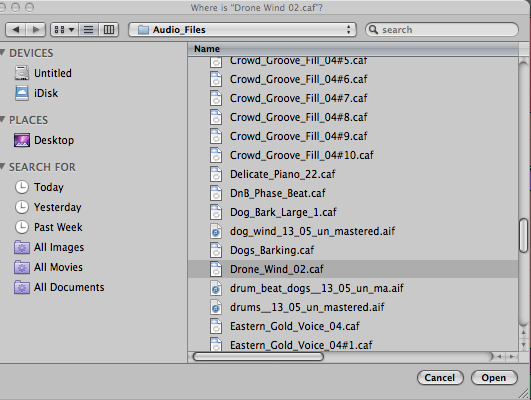
8. Open the folder called ‘Audio Files’ and locate the file you want to restore.

9

9

9.Press ‘open’ to restore the missing file to the Logic session.
9

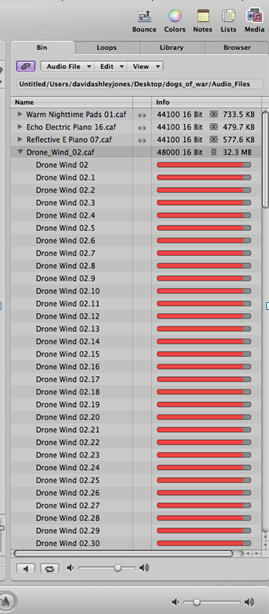
Job Done!!! The file is now safely located in your session file. You can tell also because the separate sub audio files have lit up as well in the audio bin. Repeat this process for other missing files in your session.

6

10

The final word

I hope you’ve found this tutorial useful and I hope it saves you a lot of wasted time that could be put to better use!

As I mentioned previously, I was unaware of what the Audio Bin did until about two weeks ago, when this very problem happened to me. Before using Audio Bin, if there were any files missing and I couldn’t easily locate them, I would add new elements to my pre-existing production to cater for the missing elements. Looking back, I probably wasted more time doing this instead of using the Audio Bin, but you live and learn I suppose!!

If you would like to discuss or comment about anything in this blog, then please send me an email to techniques-mixasylum@hotmail.co.uk or send me a message through my facebook page at http://www.facebook.com/mixasylum. I welcome all feedback (good or bad), or if you’ve got suggestions to make this tutorial better, then I’d love to hear from you.

Thanks, look out for my next blog soon!


David Jones


English · Tips

Musician Does Not Mean Songwriter

via deviantart.net

Chances are you are not a songwriter.

Playing an instrument makes you a musician. Playing an instrument really well and for a living makes you a pro-musician. You probably remember the time it took from learning the first chord to becoming a well-rounded musician who learns pieces quickly, even sight reads and records parts in the studio with very few takes.

All this playing, studying, all the lessons, all the gigs, all the jams, all the mistakes, all this time… all are necessary to make you the musician you are.

Now here is a surprise that really should not be a surprise. It takes a similar amount of learning about counterpoint, harmony, structure, ostinatos, lyrics, symbolism, listener perceptions, etc… to be an equally adept songwriter. Once you have done all that studying it will take a several years of writing for anything from country to twelve-tone music for your skills to become rock solid.

All the time you have spent playing has helped with an understanding of music, but it is by no means the full education required to become a great songwriter.

Just because you have written songs does not necessarily mean that you are a fully rounded songwriter either. I sometimes edit my show reels or samples from film projects I have scored. This does not make me an editor.

A little checklist:

Do fans or customers regularly pay for your music?

Do other people play your songs?

Do you know how to write four-part counterpoint?

Are you well versed in classical and jazz harmony?

Do you regularly write music on tight deadlines?

Is your work used in a commercial context?

I encounter the same phenomenon every day. There are many good musicians or singers with good ideas and concepts that managed to record a song / album that is passable. For a great album they would need a couple of years more songwriting training and a real producer. Unfortunately these artists spend their money and energy trying to force their sub-par material into the market, rather than either spending the time to improve the writing or hiring someone who can help.

The resistance to working with a professional on their music is almost comical. See my case studies article. Everyone on the Billboard charts has a team of experts, but you can accomplish this all by yourself?

While you were out playing gigs, someone else sat at up home and studied songwriting or got a degree in composition. The songwriter depends on your superior performance skills in the studio and on stage. Why would you not utilize somebody’s superior writing skills? A songwriter feels no shame having a better singer perform his music, so why is there an issue working with someone to make your songs better?

I was a full time lecturer for guitar and I still prefer to hire a professional guitarist who plays professionally and regularly. I write and produce all day. The professional guitarist will be in better shape to play.

Check out successful production teams and you will find that they have experts for each part of the production. If you are not a professional songwriter (meaning you pay your bills with your writing skills), you may want to think about the fact that you are undermining your chances as an artist, as a musician, on stage and on recordings by having an amateur create the core product for you as an artist.

There is so much music that sounds the same, so I think it is important that you fight for your unique sound and for your voice. Working with a songwriter, or an “old-fashioned” producer, does not mean that you will be turned into something you do not want to be.

It means that you will sound your best and become the artist you are meant to be. A good co-songwriter or producer will support you, sounding your best, not changing who you are.

Article by Lars Deutsch

English · Tips

Who are you? Or: How to disappear completely, while trying to get noticed

Screen shot 2014-01-20 at 17.06.08

Article by Lars Deutsch

True story.

I watched a music video yesterday. The video had a couple of good ideas and looked pretty good for an unsigned artist. The artist was female, kind of young and kind of good  looking – I guess.

I am not being difficult. I really don’t know. After watching her video, I am not sure of her age – not even ballpark. Okay, she’s likely older than 13 and younger than 40. I am not of her ethnicity and I have no idea what she stands for or who she is as an artist or a person. The video tried very hard to follow and idea of what video “should be” , so did she, and so did the music.

Speaking about the music, I have no idea what kind of voice she has, or if she can sing or write songs. Her vocals were heavily processed, a lot of the music was either loops or sounds like loops, and everything was very compressed. I don’t think there were any real instruments or any custom writing in the arrangement.

If I spent four minutes watching a video and listening to a song and I have no lasting impression, then there is something very wrong. Isn’t the idea of a video to showcase the artist? Or at least the song?

There are several tools that artists use to tune their vocals. All of them change your voice. Autotune and its clones not only tune, but also mask the true sound of your voice. Add heavy compression and a filter or two and the character and nuance of a voice are eliminated.

While she might be a good singer, a beautiful woman and an interesting person, this artist has no chance of showing it. With heavy filters on the music and visuals, she has become “any/every female singer between 14 – 39”.

She went to great lengths to hide… to be discovered.

Being interchangeable and not leaving a lasting impression is the opposite of what an artist should want. What to do?

Give your voice a chance.

Choose the microphone that works for your voice, not the microphone that happens to be in your friend’s vocal booth. Make sure that you do not eliminate the character of your voice in mixing.

Sometimes a heavy vocal effect can be a storytelling tool or there is a good reason for it.
Not being able to hit the notes should not be the reason you use effects.

Artist or DJ?

Loops are great tools, but loops do not contain your “heartbeat” or character. Loops do not respond to your vocal line. Loops do not use an inversion when you need a new color the second time around. Loops are other people’s music that you are playing, just like a DJ.

Whatever your style and background, your music should be custom-made. The fewer premade elements the better. The more you shape your material to be unique the more you are an artist. Please check out my other text about music writing for a fuller exploration of this topic.

Ok, everybody in the first row!

High frequencies make a sound appear closer. Combine high frequencies and a lot of compression and it is “in your face”. If everything has a lot of high frequency and is heavily compressed, everything is in your face. This is another good way to loose nuance and character.

Your voice might sound dull after everything else has been treated with an extra layer of high frequency and heavy compression. This usually means it is time to heavily treat the vocals as well.

While this might not be good advice for 2014, this is good music advice:

Keep everybody’s high frequencies under control, so there is a room in front of the “band” for the vocals. The end result is that the vocals will not need to be treated in order to cut through the noise.

What is hip now is not hip when you hit the market place

Having idols and learning what works is great. You might be happier and more successful aiming for something that is more ”you”.

Real life and pen and paper solutions:

Write about your topics, write songs that have your heartbeat, your sensibility and that support your stories. Stay away from producers / songwriters that would make you sound the same as their last ten productions. No sound is more unique than your voice, and you should protect it. Find a way to turn who you are and what interests you into the core of your artist persona.